
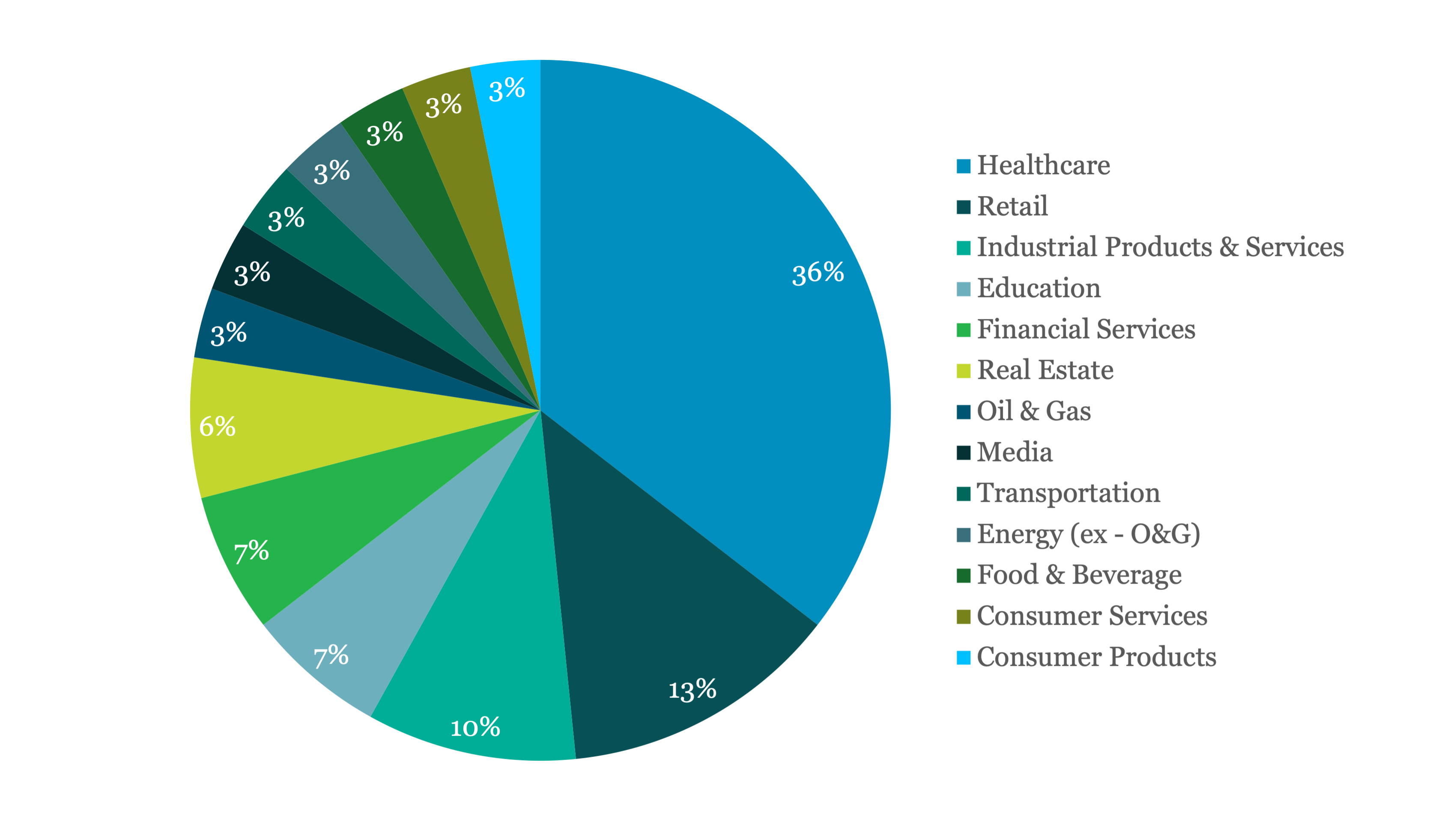
Source: Debtwire Restructuring Database
A guide to distress in healthcare
Overall, during the first quarter of 2024, there were 35 Chapter 11 applications for total debt of USD 15.4bn, of which 12 were healthcare companies, or 36% of all Chapter 11 filings, per Debtwire’s Restructuring Database.
The two largest healthcare companies by liability to file for Chapter 11 in 1Q24 were Invitae Corporation and Cano Health, with combined debt of USD 2.4bn out of the total of USD 3bn of healthcare liabilities in distress during the period.
Invitae, a medical genetics company, went through a liability-management exercise in February 2023 in an attempt to revive its loss-making fortunes. As part of its corporate restructuring, Invitae divested several business entities and privately exchanged USD 306m 2% senior convertible notes due 2024 for USD 275m 4.5% series A convertible senior secured notes due 2028 and a cash component. The group had embarked on a purchasing spree between 2019 and 2021, acquiring a string of business entities that manifest in a negative bottom-line in subsequent years. Invitae continued to burn cash throughout 2023 and, despite workforce reductions and other cost-saving initiatives, as well as the divestment of its Citizen and Natera divisions in the second half of the year, the company filed for Chapter 11 on 14 February, with USD 1.5bn of liabilities outstanding.
Cano Health, a Florida-based primary care provider, is another example of a healthcare company failing after pursuing an aggressive acquisition strategy funded by debt between 2018 and 2022. The company launched its liability-management exercise in 2023, setting out a plan to optimize operations by exiting certain markets and consolidating some others, but eventually had to file for Chapter 11 in February, with USD 900m of debt. Cano’s management had been relying on third-party medical cost reductions and the optimization of its core Medicare Advantage and ACO REACH assets; however, reimbursement rate cuts by Medicare further drained the company of liquidity.
We expect to see more companies struggle as the year rolls on. As at 20 March, there were another 13 healthcare companies rated as distressed based on their Likely-To-Distress (LTD) scores powered by Debtwire’s NextGen data, and some 28 more in the stressed universe.
Of the four companies on the distressed list with liabilities over USD 2bn, Global Medical Response (GMR) was the largest, with debts totaling USD 5.3bn. The air and ground ambulance company engaged with advisors and creditors in 2023 to amend and extend its USD 3.7bn term loan and USD 600m senior notes maturing in 2025. GMR’s operations deteriorated in late 2022-early 2023 following two fatal air accidents and persistent inflationary pressure on wages, leaving the company trying to balance retaining human capital and high financial leverage.
Team Health Holdings, a physician-staffing provider, completed a liability-management exercise in February for its remaining term loan B, senior secured PIK loan and revolving credit facility. However, the company still needs to address its USD 714m notes due February 2025, while its cash-generating capacity is constrained and leverage remains high. Team Health’s operations are likely to be further impacted by lower collectibles stemming from the Medicare rate cuts and extended dispute resolutions determined by the No Surprises Act.
Dialysis provider US Renal Care completed a distressed debt exchange in summer 2023 in order to optimize its capital structure, but its debt load of USD 2.4bn appears unsustainable given decreased cash flows.
EyeCare Partners also faces challenges servicing its debt because of a very limited capacity to generate cash. The company cited staffing shortages and higher inflationary costs as the main reasons for poor cash generation, which are the same underlying problems afflicting US Renal Care.
We anticipate the healthcare restructuring pipeline getting even busier as the year progresses, with many services providers beleaguered with third-party payment overheads stemming from Medicare’s revised payment rates, the backlog of medical bills stuck in dispute-resolution processes and high inflationary labour costs. While the rate of inflation increase has slowed based on the latest Consumer Price Index data from the US government, we believe there needs to be a significant fall before healthcare companies are able to climb off their sickbeds and start to recover their liquidity and leverage.
For access to our comprehensive news, analysis and data on the global loan and bond markets, please subscribe to Debtwire.
(Past performance is no guarantee of future results.)



Latest news
Top 50 BDCs Accounted for 75% of Nonaccrual Loan Cost in Q2’26
The 50 largest BDCs, on the basis of total debt investments as of the second quarter of 2026, accounted for 75% of the total aggregate reported value of nonaccrual debt at cost and fair value.

US private debt AUM ($B) by channel
In 2025 and the early part of 2026, the retail channel added AUM to the asset class at a much faster rate than institutional investors in both regions, with growth rates of 43.7% globally, 41.4% in the US, and 73. 1% in Europe through the beginning of 2026 compared with year-end 2024 figures.