
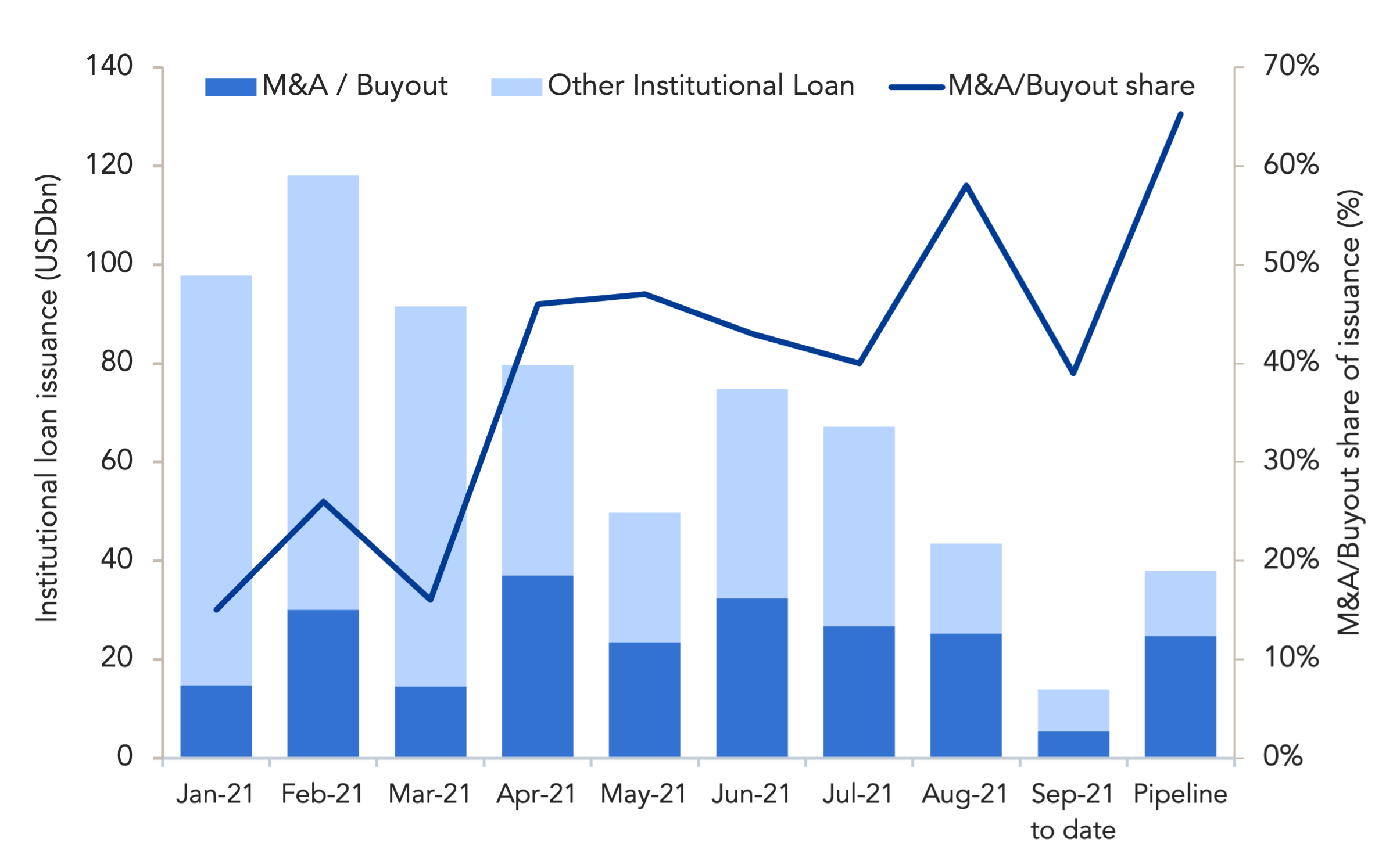
Source: Dealogic, Debtwire Par
With institutional issuance slowing to USD 43.6bn in August, its lowest level in the year to date (YTD), a steady flow of M&A and buyout related financings (USD 25.2bn or 58% of monthly issuance) and a slowdown in refinancing transactions (USD 12.2bn or 28% of issuance) contributed to an overall increase in loan pricing. Borrowers looking to finance acquisitions with debt have regularly had to pay a premium.
Wahoo Fitness, for example, issued a USD 225m TLB due 2028 to support its buyout by Rhone Group. The fitness technology company was forced to widen pricing from talk of Libor+ 525bps-550bps and a 99 OID to L+ 575bps and a 97 OID in order to complete the transaction. Eastman Tire Additives similarly saw pricing flex during the syndication process, with final pricing of L+ 525bps and a 98 OID landing wide of initial talk at L+ 475bps-500bps and a 99 OID. Proceeds support the acquisition of Eastman Chemical Company’s tyre additives business by One Rock Capital Partners.
Of the more than USD 38bn of institutional loans currently in syndication, well over half are allocated towards M&A and buy-out purposes. Issuers including DexKo Global and PS Logistics are expected to price buyout related loan financings in the coming days, with margins talked in the L+425bps area. Average margins on first lien M&A/buyout loans currently in syndication stand at 389bps, with initial talk as tight as L+ 200bps on Catalent Pharma‘s USD 450m TLB add-on to fund its acquisition of Bettera Holdings, and as wide as L+500bps on Team Services Group‘s USD 90m incremental TLB to fund a tuck-in acquisition.
(Past performance is no guarantee of future results.)



Latest news
Top 50 BDCs Accounted for 75% of Nonaccrual Loan Cost in Q2’26
The 50 largest BDCs, on the basis of total debt investments as of the second quarter of 2026, accounted for 75% of the total aggregate reported value of nonaccrual debt at cost and fair value.

US private debt AUM ($B) by channel
In 2025 and the early part of 2026, the retail channel added AUM to the asset class at a much faster rate than institutional investors in both regions, with growth rates of 43.7% globally, 41.4% in the US, and 73. 1% in Europe through the beginning of 2026 compared with year-end 2024 figures.