



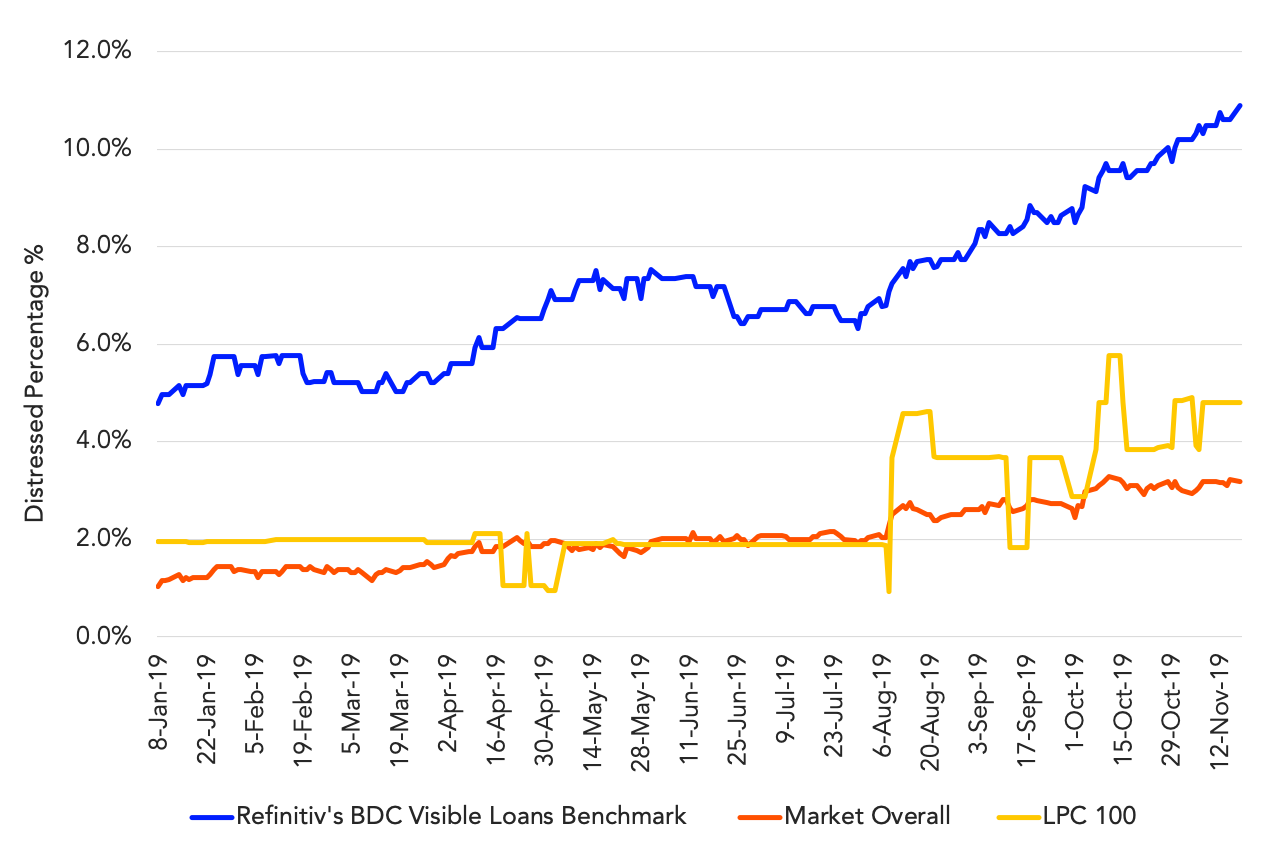
For several years in an asset and yield starved market, BDCs stretched up the risk spectrum in an effort to keep up their lofty dividend yields. As the credit environment becomes tougher this year amid slowing global growth, more cracks are beginning to surface in BDC holdings. So far based on 3Q19 earnings reports, over 80% of BDCs reported a decline in Net Asset Value per share signaling that the credit environment is starting to deteriorate. Based on BDC holdings that have visible marks with LPCs’ mark-to-market pricing service, the share of loans entering distressed territory continues to grow this year. So far following 3Q19 earnings, roughly $17bn in BDC loans have MTM pricing with $2.0B showing an average bid of less than 80, which implies the distressed percentage has risen above 10%. This is a stark rise compared to the beginning of 2019, when BDCs only showed a distressed percentage of around 4%. And BDC’s distressed percentage is currently well above the overall market and LPC’s 100 most liquid loans which reside at 3.2% and 4.8%, respectively. The average bid on Refinitiv LPC’s BDC Visible Loan Benchmark resides at around 91.7 compared to 97.3 for LPC’s 100 most liquid loans.




Latest news

PE dry powder
The capital that is being raised is flowing overwhelmingly to the largest, most established managers.

Middle market debt held by BDCs vs High yield vs Treasury yields
The blue line represents the current dividend yield of the VanEck BDC Income ETF (BIZD), which stood at 11.7% as…

LevFin Issuance Slows Across Products in August; DCM Remains a Bright Spot
The leveraged capital markets business continued to decelerate from just about every aspect, even for August standards. Overall issuance (including…