



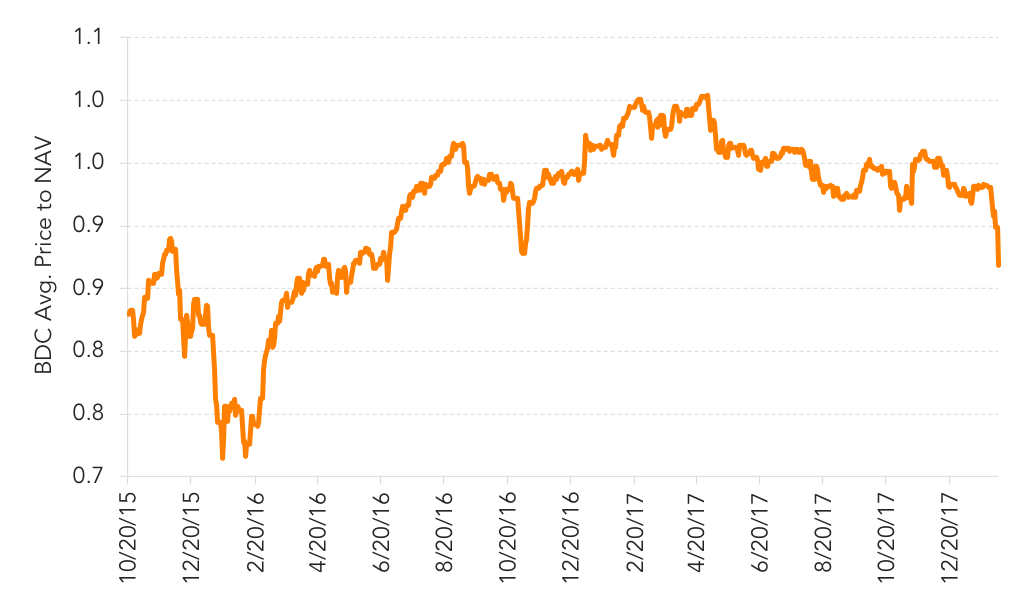
For those investors that are bullish on BDCs, this week was a prime buying opportunity as the middle market debt managers were engulfed in equity market wrath earlier this week. The average share price to book value for the public universe plummeted on Monday to 0.87 times, the lowest level since mid 2016. In fact, only 13% of the public BDCs were still trading above book value, down from 30% in December 2017. BDC share prices can be volatile as they are tied to the equity markets even though the underlying assets are relatively stable and reflective of the credit environment, which remains benign. This can create enticing buying opportunities for those investors that have a favorable view of middle market loans. However, it is BDC earnings season and the story on earnings calls is likely to be more of the same – extremely competitive market conditions and spread tightening. Given BDCs’ high fee and yield structure, these players have struggled to stay relevant in the middle market given the huge influx of capital seen in the last two years. The BDCs are hopeful that some positive regulatory changes could happen this year to help boost interest and investing capacity in the space. For example, BDC managers have their fingers crossed that Congress will increase the leverage limit from 1.0 times debt to equity to 2.0 times via the BDC Bill. Furthermore, managers are hopeful for a revision to the AFFE (Acquired Fund Fees & Expenses) which really hurt institutional investor interest in the BDC space when it was enacted a few years ago.
Contact: Fran Beyers
frances.beyers@thomsonreuters.com

Latest news

Share of PE middle-market deal count by backing type
Add-ons remain the workhorse for middle-market deployment, accounting for 67. 1% of all middle-market transactions YTD, in line with activity seen in recent years.

Software deal share falls in middle markets, rises in large caps
In Q3’26 software’s share of total deals fell in both the Lower Middle Market (to 7%) and Upper Middle Market (to 9%), while Large Cap saw a modest uptick in share to 8%.

Secondary loan prices stabilize following steep declines
Secondary loan prices came under significant pressure through September and October, with the Bloomberg U.S. Leveraged Loan Index declining 119…