Unitranche in price discovery mode, likely moving back over 600bp

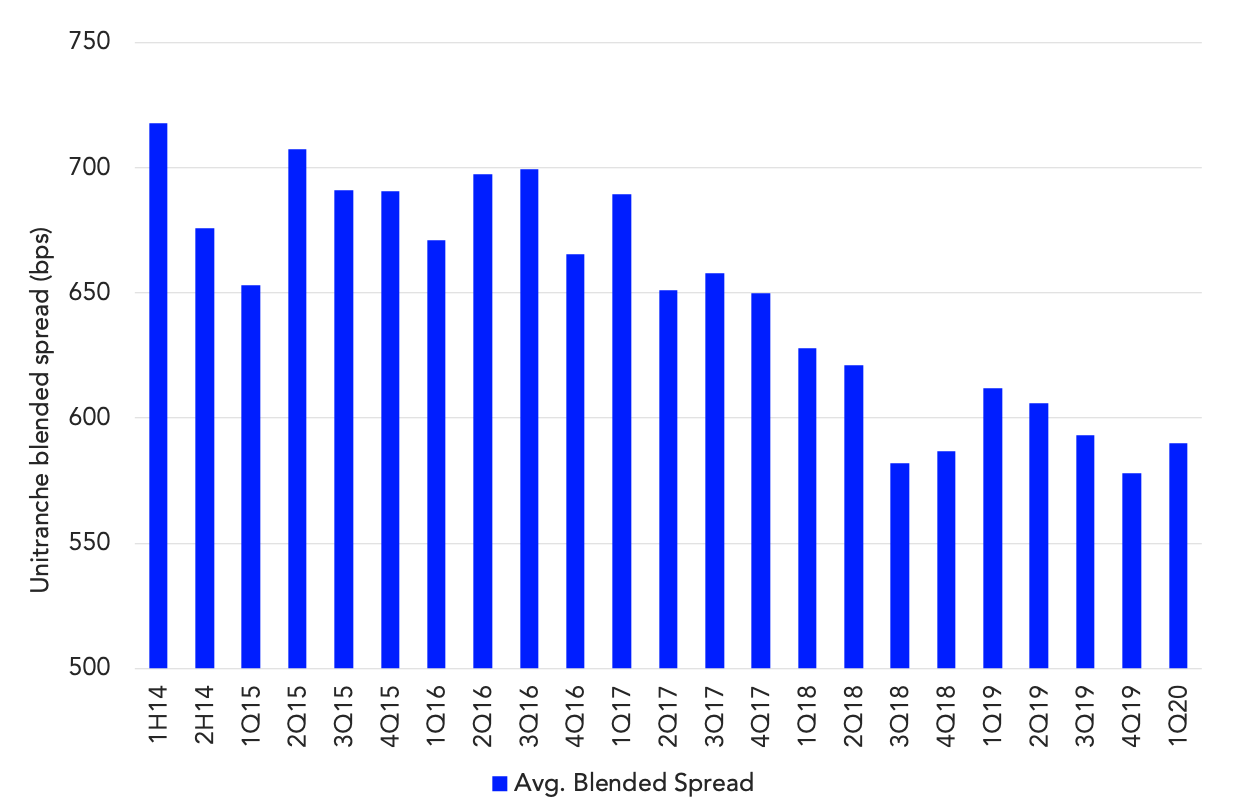
Amid falling Libor and more volatile pricing conditions in the syndicated market, unitranche pricing is moving higher after hitting rock bottom levels in 4Q19. So far in 1Q20, the average blended spread on a unitranche is 590bp, up from a low of 578bp in 4Q19. And it is likely that the average will move into the 600bp area near term. “Unitranche pricing is case by case and is running the gamut from as low as 575bp all the way up to 700bp. We are in price discovery mode, but it feels like most lenders want at least 625-650bp right now,” said a direct lender. Sponsors were hitting the institutional loan market in January and February with first-lien/second-lien deals amid strong demand but recent volatility is now steering sponsors back to the direct lenders for larger scale unitranches. “It is only a matter of time before you see those big mega tranches return,” added another direct lender. Direct lenders are still open for business given they have hordes of cash they are anxious to put to work. However, they are being more disciplined on Libor floors (must have them), and on increasing spreads roughly 25-50bp relative to last quarter. A lot more regular-way first-lien deals are pricing over 500bp right now versus the 450-475bp market we had in 2019. Lastly, law firms indicate sponsors are being slightly more accommodating on document negotiations relative to last year in an effort to close deals quickly amid volatile conditions.



Latest news
Top 50 BDCs Accounted for 75% of Nonaccrual Loan Cost in Q2’26
The 50 largest BDCs, on the basis of total debt investments as of the second quarter of 2026, accounted for 75% of the total aggregate reported value of nonaccrual debt at cost and fair value.

US private debt AUM ($B) by channel
In 2025 and the early part of 2026, the retail channel added AUM to the asset class at a much faster rate than institutional investors in both regions, with growth rates of 43.7% globally, 41.4% in the US, and 73. 1% in Europe through the beginning of 2026 compared with year-end 2024 figures.