



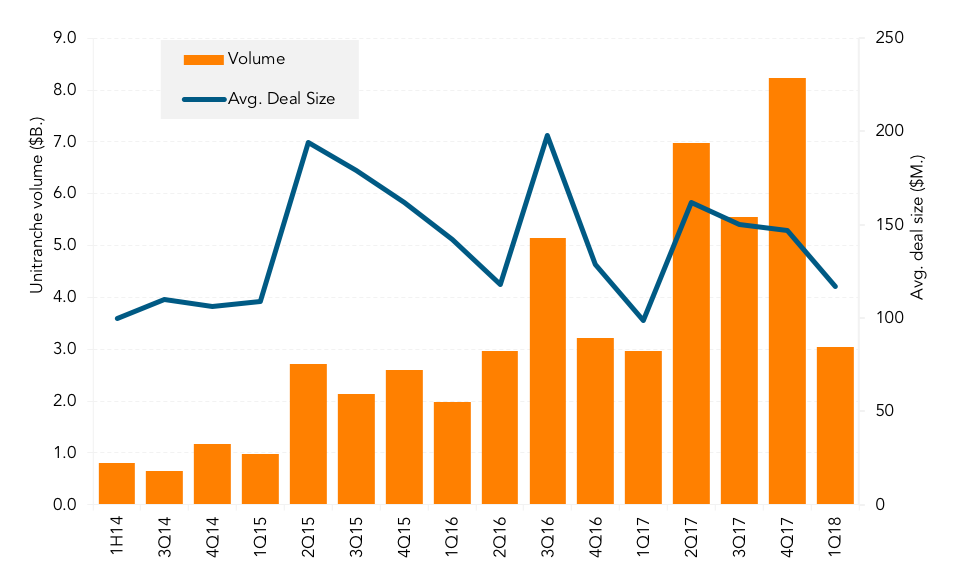
Thomson Reuters LPC’s newest unitranche league table provides insight into a very private, opaque market. After peaking at a robust $8.2B in 4Q17, unitranche volume fell off a dramatic 63% in 1Q18. What drove the fall off? Sponsors typically gravitate to the unitranche for ease of execution in M&A deals. But given that refinancings and repricings dominated volume in 1Q18, sponsors instead opted for the cheaper all senior structures to shave spreads last quarter. “As we enter the final stages of the credit cycle, sponsors are smart to cut spreads and build a buffer in for middle market issuers to help them gain resiliency,” said a lender. The average deal size also dropped to just $117M from $147M last quarter as many larger middle market issuers found the syndicated market wide open and enticing in 1Q18. As the year progresses and M&A materializes, it is very likely that unitranche financings will pick up momentum once again. Spreads on unitranches continued to drop in 1Q18 down to 633bps from 661bps in 2017 and 686bps in 2016. However the rise in Libor resulted in rising unitranche blended yields to 9.16% in 1Q18 from 8.84% in 4Q17 and 8.43% in 3Q17. Average leverage on the unitranche structure remains relatively steady at around 5.25 times.
Contact: Ioana Barza
ioana.barza@thomsonreuters.com



Latest news

US Leveraged Loans Return 3.36% to Investors YTD
The Bloomberg US Leveraged Loan Index (Ticker: LOAN) returned 0.96% in August and has gained an additional 0.28% through September…

PE dry powder
The capital that is being raised is flowing overwhelmingly to the largest, most established managers.

Middle market debt held by BDCs vs High yield vs Treasury yields
The blue line represents the current dividend yield of the VanEck BDC Income ETF (BIZD), which stood at 11.7% as…