
On the back of increasingly unsettling global headlines, the capital markets took a beating earlier this month. As the equity markets tumbled, the US high yield bond market likewise saw skittishness culminating in an outflow of over $7 billion during the week of August 6 alone, before observing a rebound via over $2 billion in inflows. 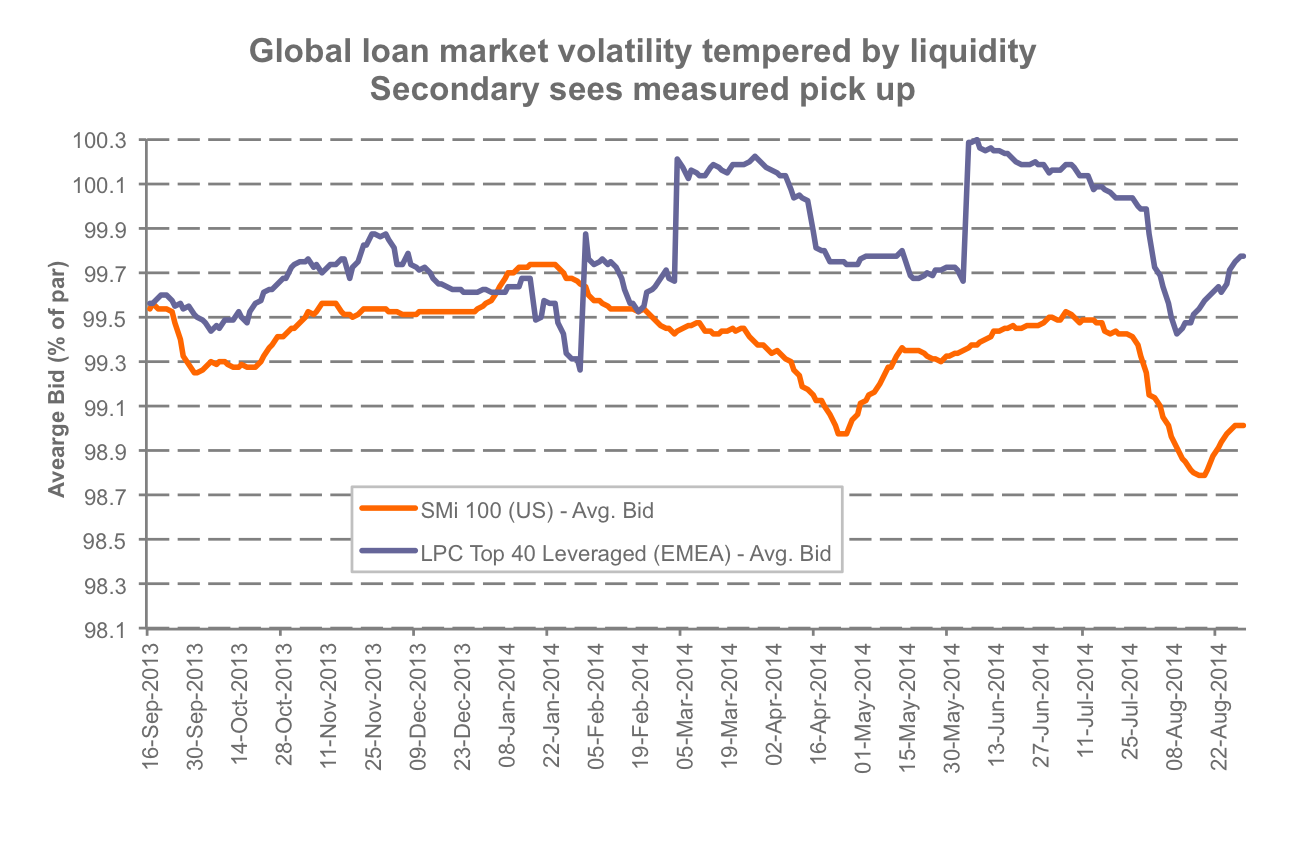 Unsurprisingly, the loan market experienced similar unease in tandem with that of the broader capital markets. Loan retail funds saw nearly $1.5 billion in outflows the week of August 6, the largest weekly exodus of liquidity since 2011, before showing some restraint in the weeks that followed. Globally, pricing corrections and demand for tighter credits resurfaced and issuers took pause to either tweak financings already in market or to postpone planned credits in the hope that better market conditions would re-emerge in September. In both the US and European loan markets, the secondary likewise took a hit as bids tumbled from 99.15 and 99.88 at the beginning of the month to lows of 98.79 and 99.48 within the SMI 100 (which tracks the 100 most widely held loans) and the Lev 40 respectively. Despite the broader market turbulence however, natural loan market investors remained in place with CLO issuance approaching $77 billion so far this year. In turn, secondary bids have slowly crept up with the SMI 100 and Lev 40 finishing August at 99 and 99.78 respectively. Underliers



Latest news

Top 50 BDCs Accounted for 75% of Nonaccrual Loan Cost in Q2’26
The 50 largest BDCs, on the basis of total debt investments as of the second quarter of 2026, accounted for 75% of the total aggregate reported value of nonaccrual debt at cost and fair value.

US private debt AUM ($B) by channel
In 2025 and the early part of 2026, the retail channel added AUM to the asset class at a much faster rate than institutional investors in both regions, with growth rates of 43.7% globally, 41.4% in the US, and 73. 1% in Europe through the beginning of 2026 compared with year-end 2024 figures.