


Markit Recap – 10/16/2017

Wind CDS orphaned?
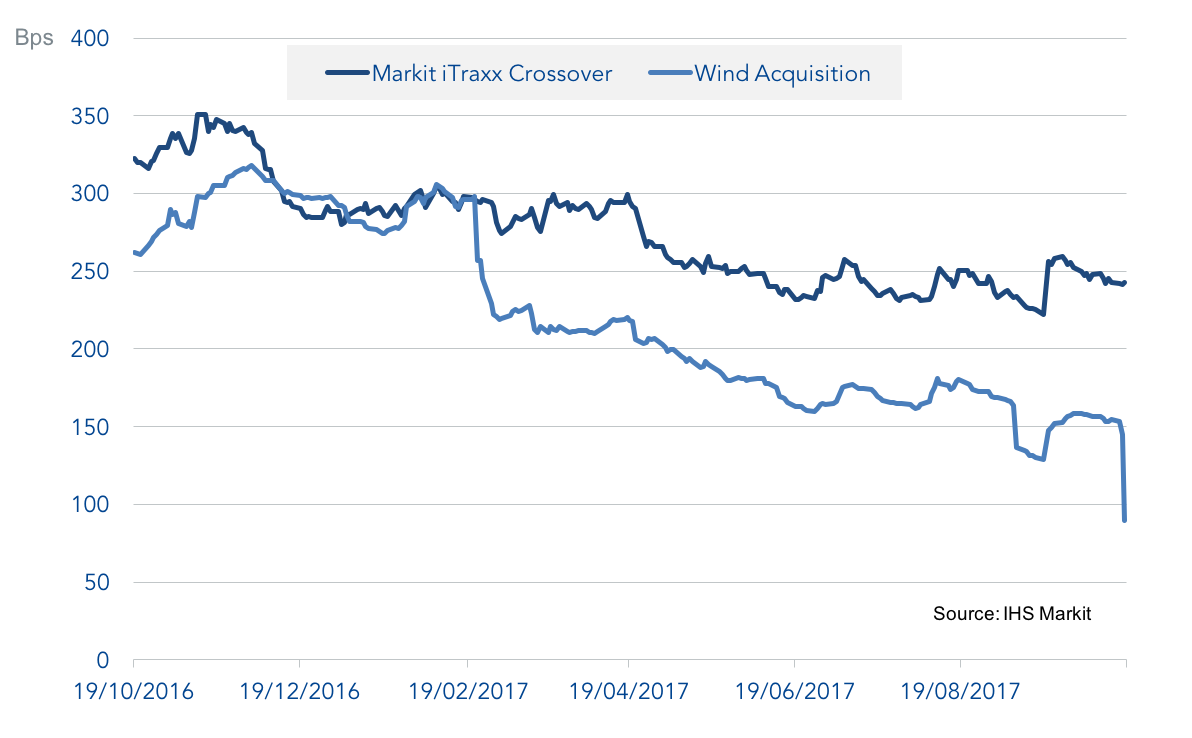
We noted last month that orphaned CDS seemed to be on the rise, with both EDP in Portugal and Italy’s Wind possibly losing their relationships with deliverable obligations. The picture was clear with EDP – bonds will be issued out of EDP Finance BV and this was reflected in the entity’s inclusion in the latest series of the Markit iTraxx Europe.
But the situation was somewhat opaque with Wind. Reports of a refinancing that would orphan Wind Acquisition Finance (WAF) were circulating, but no concrete news was released. That changed this week when the company announced details of the refinancing. Wind Tre SPA, the new holding company formed at the beginning of this year, will issue €7.3bn of senior secured bonds. The proceeds, along with €3.4 billion in credit facilities, will be used to repay all the obligations of WAF.
On the face of it, the new capital structure and the implications for CDS seem quite clear. Wind Tre SPA is the new issuer of debt, leaving WAF without deliverables and therefore orphaned. But there is a catch. WAF is the guarantor of the debt issued by Wind Tre. If the guarantee is qualifying, then WAF would likely remain as the CDS reference entity. In that case, the spread tightening last month would be unwarranted and the episode dismissed as storm in a teacup.
But the market reaction suggests the opposite – WAF spreads have rallied dramatically. Five-year levels went from 145bps to 89bps in the space of a single day, suggesting that orphaning is still very much on the cards. Why would this be the case? In short, it all depends on whether the guarantee is qualifying or not.
To recap, a guarantee has to be qualifying if the deliverable obligation of the reference entity is ‘good’ for settling CDS. This was a bone of contention under ISDA 2003 definitions, and there were several changes under the 2014 definitions to ensure more guarantees were qualifying. In particular, a cap on the guarantee is now permitted under 2014 rules, as well as exemptions for release clauses.
Despite the softening of the language, however, it seems that some guarantees can still fail to meet the ‘qualifying’ criteria. The sharp spread tightening in WAF implies orphaning – the consensus appears to be that the guarantee is not qualifying. Unless the legal view of CDS markets makers changes, WAF spreads will remain at tight levels and liquidity may dwindle.
Contact: Gavan Nolan
Gavan.Nolan@ihsmarkit.com




Latest news

The Recovery Shot
Trouble off the tee doesn’t always translate to trouble on the scorecard.
Q2'26 BDC analysis shows additional 184 bps of nonaccruals at cost
In a universe of 173 business development companies, or BDCs, Octus identified a total of $9.5 billion of debt (at cost) in nonaccrual status reported in the second quarter of 2026, a slight decline of 5% from $10 billion in the first quarter of 2026.
Private Credit Defaults 101: Scrambling for Par
Seve Ballesteros won four majors in the 1980s despite being, by his own admission, one of the wildest drivers of the golf ball on tour.