


Markit Recap – 11/10/2014

Geopolitical risk was all the rage earlier this year, and played a major part in credit spreads widening in a number of short, sharp bursts. Monetary policy soon resumed its role as the main driver of sentiment, but there were indications this week that it may have to move aside.
Ukraine saw its CDS spreads widen 125bps on November 12, and are now at their widest level since December 2009. Prices in the cashmarket also collapsed, a reflection of renewed concerns that the conflictwith Russia may be about to flare up again. Reports that Russian troops have entered eastern Ukraine were reminiscent of the incursion in August. The military presence was subsequently withdrawn, but if the reports are true, then we could be seeing further escalation.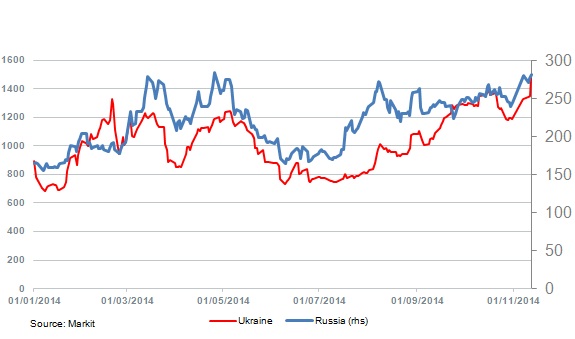
Ukraine’s CDS spreads breached 1,000bps in August – a significant move at that time. But now they are being quoted at 1,475bps, and the curve is steeply inverted – a typical sign of credit distress. Angela Merkel indicated on November 11 that the EU is not planning further sanctions on Russia, which may lead some in the market to expect additional military incursions into the Ukraine.
Credit investors have their eyes on Ukraine’s dwindling foreign exchange reserves, and the currency is rapidly losing value after the central bank abandoned it unofficial peg last week. The depreciation places immense pressure on the country’s banking system, and there is no sign of the IMF increasing its inadequate bailout programme agreed in April.
So, it is no surprise that the CDS markets are pointing towards a probability of default in excess of 60%. But it should be noted here that Ukraine’s CDS are by no means the most liquid in the sovereign market. Few dealers regularly quote the name, and the bid-offer spreads tend to be around the 100bps level, according to Markit liquidity metrics. Fast money investors that often get involved in high beta trades may not be quote as keen as they once were.
Russia’s CDS, on the other hand, is among the most liquid in the market. It regularly ranks in the top 10 active names (DTCC), trades with a bid-offer spread of about 3bps and has a plethora of banks making markets on the sovereign. Russia is trading at 281bps, its widest level since April, and if the conflagration in eastern Ukraine intensifies we can expect spreads to widen further.
Contact: Gavan Nolan




Latest news

PE middle-market pooled IRR and TVPI by TEV size bucket
The lower end of the middle market has generated better returns on average and does not come with significantly more left-tail risk


Investors exit retail loan funds in July
Investors in leveraged loans have been pulling money from retail funds in recent weeks, with redemptions outpacing investments by $253.3b…