


Markit Recap – 2/20/2017

The political polling industry is suffering a crisis of credibility after failing to predict Brexit and Donald Trump’s victory in the US presidential election. A thorough overhaul of its methods is surely needed.
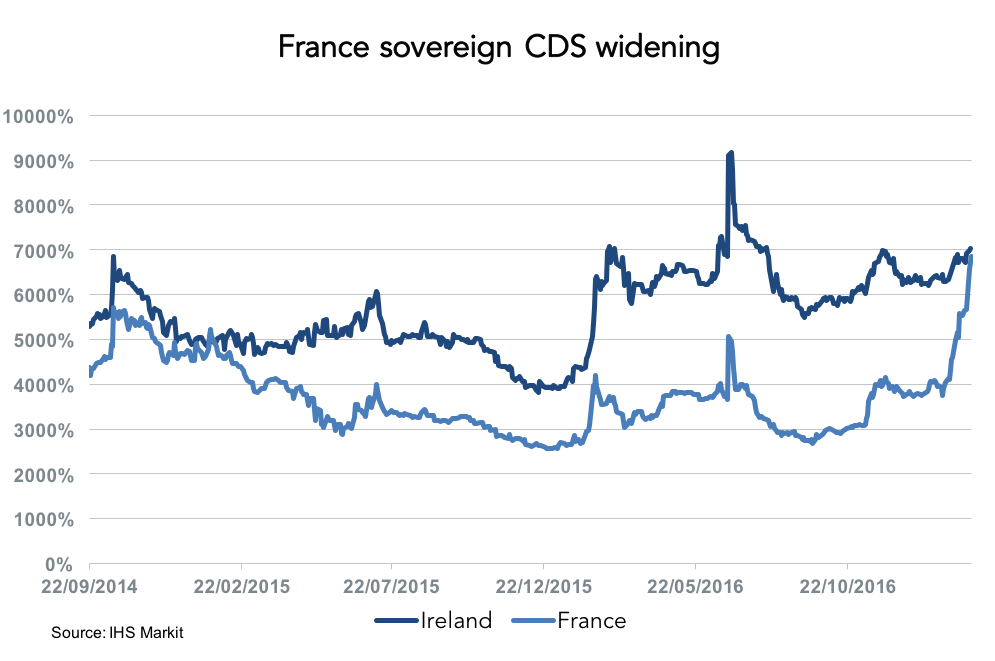
But in a world where political risk is more potent than ever, investors have little else to go on, and polls still have the potential to trigger considerable market volatility. A prime example this week was France, where polls showed far-right – and anti-euro – candidate Marine le Pen increasing her lead in the first-round presidential vote. The reaction in the credit markets was significant – French sovereign CDS widened from 56bps to 68bps in the space of three days, and is now over 40bps wider than levels reached in the post-Brexit aftermath of September 2016.
The deterioration in France’s credit standing – in the eyes of the CDS market at least – prompted media comparisons with the eurozone’s peripheral countries. France is now trading in line with Ireland for the first time since early 2015, and is now just 12bps tighter than Spain, so the comparison is understandable.
But it should be noted that sovereign CDS are now trading much tighter than levels during the Eurozone crisis, so a level of 68bps, while wide for France, is not indicating any credit distress.
The legal structure of the CDS market also has to be taken into account. France’s 68bps level is under the ISDA 2014 definitions; the spread for the ISDA 2003 equivalent is 47bps. The basis between the two contracts was negligible until a few weeks ago, when it started to widen amid the Le Pen headlines.
So want drives the basis? Western European sovereigns under the ISDA 2014 contract include “Asset Package Delivery”, a clause inserted to prevent the debacle of the Greek credit event in 2012. This should give a more accurate recovery rate, and protection holders will pay more for its reassurance. But the 2014 definitions also address the issue of a country leaving the Eurozone, an outcome that was treated with ambiguity under 2003 documentation. Whether this makes the 2014 contract more likely to trigger is debatable – if there is an active currency market in the new currency it may not be a credit event – but the clearer language makes the 2014 contract more valuable for protection holders. Italy has long had a large 2003-2014 basis – currently around 40bps – but this is a recent phenomenon for France.
Will this basis widen even further? Polls suggest that Le Pen would still lose the second round comfortably, a result that would clearly be positive for French credit. But if polling shows Le Pen gaining on the establishment candidates in the run-off, then it would be no surprise to see the basis expand beyond 20bps. 2017 will be a year where markets are beholden to politics, and credit investors will use the sovereign CDS market to muddle their way through the uncertainty.
Contact: Gavan Nolan
Gavan.Nolan@ihsmarkit.com



Latest news

European mid-market direct lending margins face steady compression since 2024
European mid-market direct lending margins have seen consistent compression over recent years but recorded a slight increase in the second quarter of 2026…

US leveraged loan issuance rebounds in September
Following three consecutive months of declining issuance, the US leveraged loan market has reversed course in September. Approximately $48.7b of…

Reversion to the Mean
Climbing toward the average is a very different story than surpassing it.