


Markit Recap – 2/22/2016

Last summer saw investors turn to shorting bond ETFs as the bond market kicked back to into life amid the Greek crisis. Volatility has continued in earnest in 2016 as the Markit iTraxx Europe index, which tracks CDS spreads across investment grade issuers, hit a three year high of 121 bps earlier this month. The surging credit risk across Europe (and globally) has seen investors short European listed bond ETFs with renewed vigour.
This comes as the aggregate value of short positions across the asset class crossed the $1bn mark for the first time ever in February to top out at $1.16bn last Monday.
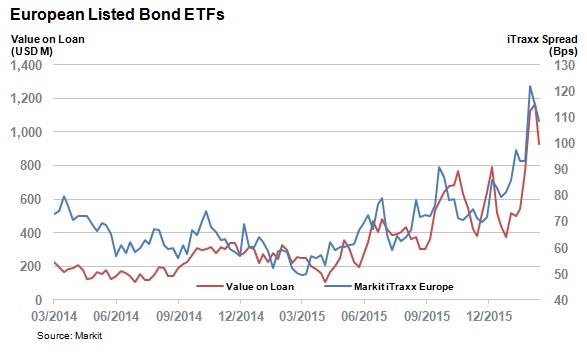
While short interest across the asset class has receded back under the $1bn in the last week, the current $930M of aggregate short positions is still higher than that seen at any point last year, which shows that bearish sentiment across bonds is still highly elevated.
The products that have attracted the most bearish sentiment in the recent wave of shorting activity have been on the riskier end of the scale as two high yield funds currently top the list of the most borrowed European bond ETF. The two funds, the Ishares $ High Yield Corporate Bd Ucits ETF and Ishares Euro High Yld Corporate Bd Ucits ETF make up over half of the current short base as both funds now have more than $250m of shares out on loan.
Emerging market bonds have also been in the crosshairs as the Ishares J.P. Morgan $ Emerging Markets Bond Ucits ETF saw as much as $215m of borrow in recent weeks.
The fact that investors now use ETFs to short US high yield and emerging market bonds speaks volumes about the growth of European ETFs in recent years. Investors now use the asset class to express both long and short views on an increasingly diverse set of asset classes. In fact, investors can now access an all-time high $4.1bn of European listed bond ETFs now sitting in lending programmes, a number that has grown by 6% ytd, twice the rate of AUM growth seen by European ETFs.
The bond ETFs asset sitting in lending programmes are also proving increasingly lucrative to beneficial owners willing to lend them out. The increased demand to borrow the asset class in recent weeks has seen the stock lending revenue generated by bond ETFs sitting in lending programmes jump to a recent high of 25 bps on an annualised basis.
This trend is highly concentrated towards a minority of funds which see the most demand to borrow and in turn generate the most stock lending revenue however. In fact, five funds make 85% of the current annualised stock lending revenues.
Contact: Gavan Nolan
Email: Gavan.Nolan@markit.com




Latest news

Q2'26 BDC analysis shows additional 184 bps of nonaccruals at cost
In a universe of 173 business development companies, or BDCs, Octus identified a total of $9.5 billion of debt (at cost) in nonaccrual status reported in the second quarter of 2026, a slight decline of 5% from $10 billion in the first quarter of 2026.

Reading the Board
The story changes depending on which numbers you’re counting.
Private Credit Defaults 101: Different Numbers, Different Stories
In Season 2 of Billions, Bobby Axelrod takes his lawyer Orrin Bach to an empty Yonkers racetrack in the dead of night.