


Markit Recap – 3/26/2018

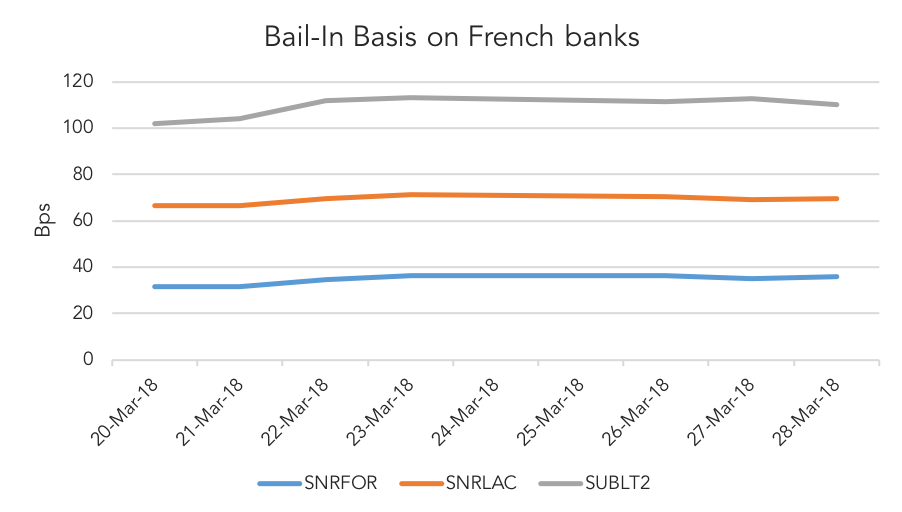
We’ve had eight business days of trading since the index roll on March 20, a date that will be remembered in the CDS world for the introduction of the new senior non-preferred tier (SNRLAC).
Perhaps it is too early to give a definitive assessment of how the tier is performing relative to the rest of the capital structure. After all, it took some time before the ISDA basis found its feet after the 2014 definitions came into effect. But it is still worthwhile to take a preliminary look at the price action as we go into quarter-end.
What we see is largely in line with what we expected from observing the HoldCo/OpCo basis prior to the roll. SNRLAC spreads on the French banks (the chart shows an average of BNP, Soc Gen and Credit Agricole – all of which are trading in a close range) are roughly double that of senior preferred (SNRFOR). Approximately the same absolute basis is seen between SNRLAC and subordinated lower tier 2 (SUBLT2). The latter have widened disproportionately during the recent period of risk aversion, which is again expected behavior.
But the widening in SNRLAC is slightly less than SNRFOR. This is counter-intuitive, as senior non-preferred debt acts as a buffer for senior preferred in the event of a resolution and consequent bail-in. This may well be down to differences in liquidity, and the market may shift in a more predictable fashion as market depth in the new tier increases. One also has to bear in mind the credit quality of the banks in question – the three French institutions have strong balance sheets and trade at tight levels, so the probability of the SNRLAC buffer being necessary is small.
The inclusion of the SNRLAC tier in the latest indices may also have had an impact on the basis between the Markit iTraxx Europe and iTraxx Senior Financials. The latter index is now trading 6bps wider than the Main, whereas before the roll it was just 2bps difference. A similar widening in the basis was seen after the inclusion of HoldCos in the September 2017 roll. The three banks make up a larger weight in the Senior Financials than the Main, so the widening in the basis is unsurprising.
We will monitor the relative performance of SNRLAC throughout the year. Other names may start to see quotes in the coming months, though the lack of central clearing may limit liquidity and restrict them to bilateral only. But it is inevitable that the SNRLAC universe will increase given the TLAC and MREL deadlines and the rise in issuance eligible for loss absorption regulation.
Contact: Gavan Nolan
Gavan.Nolan@ihsmarkit.com



Latest news

US Leveraged Loans Return 3.36% to Investors YTD
The Bloomberg US Leveraged Loan Index (Ticker: LOAN) returned 0.96% in August and has gained an additional 0.28% through September…

PE dry powder
The capital that is being raised is flowing overwhelmingly to the largest, most established managers.

Middle market debt held by BDCs vs High yield vs Treasury yields
The blue line represents the current dividend yield of the VanEck BDC Income ETF (BIZD), which stood at 11.7% as…