Markit Recap – 4/4/2016

Investors embrace long dated corporate bonds
Investors have been loading up on relatively higher yielding long term corporate bonds, in spite of the asset class seeing its average credit rating decline in recent years.
- Long dated corporate bond ETFs have seen $90m of inflows ytd, over twice the 2015 total
- BBB bonds make up 47% of the Markit iBoxx $ Corporates 10Y+ index, up from 41% in 2011
- Long dated US corporates have returned 7% year to date, twice that of conventional bonds
The desperate quest for yield in the fixed income market has made relatively higher yielding long dated bonds irresistible in current market conditions. ETFs tracking the asset class have seen their best ever quarterly inflows in the opening three months of the year, according to Markit’s ETF analytics database.
While the majority of the inflows have been aimed at products that invest in government bonds, a small but growing portion of inflows have ended up in corporate bond funds which tend to invest in investment grade debt with a maturity greater than ten years. These bonds tend to offer a relatively higher yield than the average investment grade bonds bonds; 0.61% more for EUR denominated investment grade and 0.79% for USD debt, but also come with the increased risk linked to their longer maturity.
But increased risks associated with longer maturities hasn’t put off investors, as the 11 long dated corporate bonds ETFs have seen $90m of inflows since the start of the year – over twice the haul seen over 2015 in total. These flows were the strongest in March when a newly dovish Fed and the inclusion of investment grade corporate bonds into the ECB’s quantitative easing basket saw investors park $200m into long dated corporate bond funds.
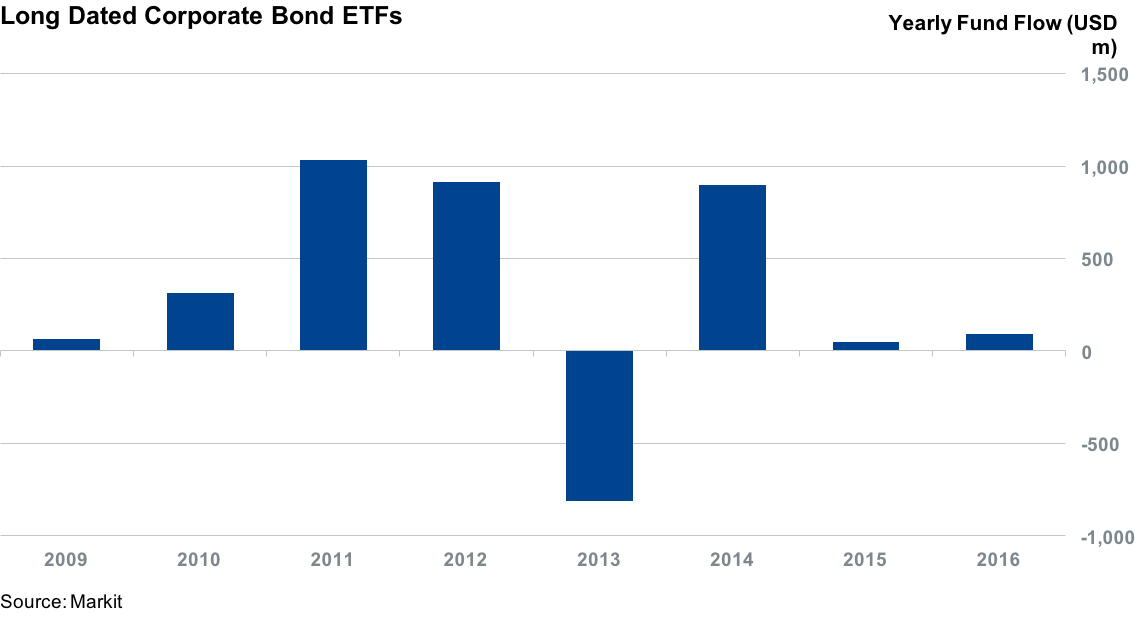
This trust in the asset class has proved to be a winning strategy so far this year as long dated dollar-dominated investment grade bonds which make up the iBoxx $ Corporates 10Y+ index have delivered a total return of 7% in the opening three months of the year, which is nearly twice those delivered by the benchmark investment grade universe.
While the dynamics have been positive for the asset class this year to date, it’s worth noting that duration risk among these long dated debt instruments could see returns wiped out, given that this measure of risk is twice as high as than the overall Markit iBoxx $ Corporate Index.
Asset class riskier
Another potential risk faced by investors loading up on long dated corporate bonds is credit risk. The asset class has seen a deterioration in credit worthiness in recent years as lower rated companies profited from loose monetary policy to issue longer dated bonds.
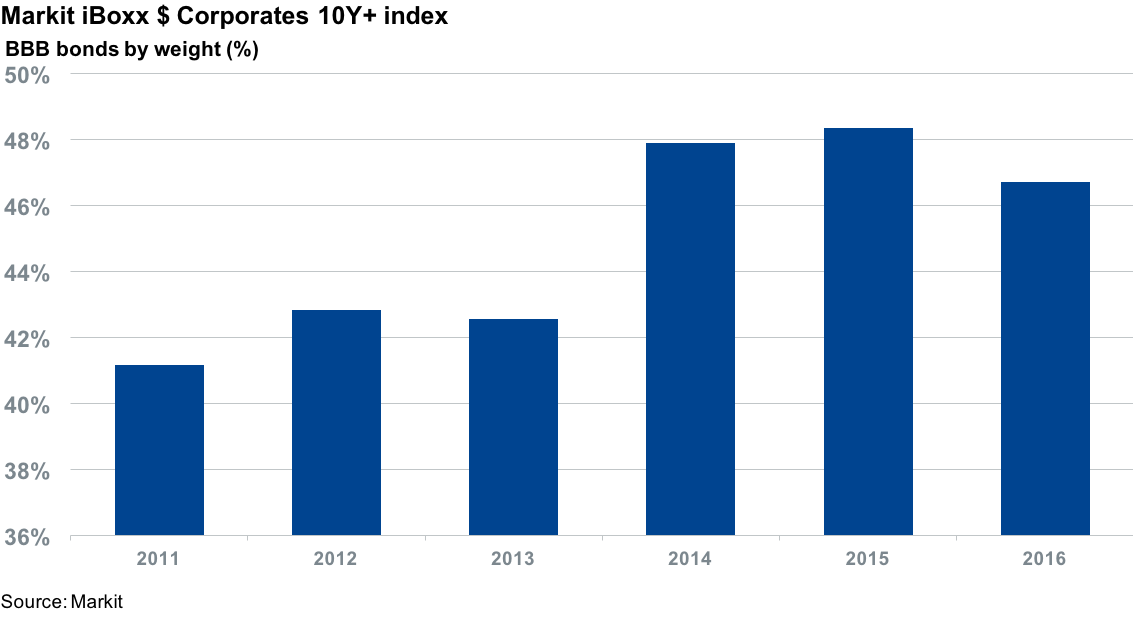
To this end, the portion of BBB rated bonds in the Markit iBoxx $ Corporates 10Y+ index, the lowest rung in the investment grade ladder, has grown to 47% over the last five years from 41% in March of 2011.
Contact: Simon Colvin
Email: simon.colvin@markit.com


Latest news

Top 50 BDCs Accounted for 75% of Nonaccrual Loan Cost in Q2’26
The 50 largest BDCs, on the basis of total debt investments as of the second quarter of 2026, accounted for 75% of the total aggregate reported value of nonaccrual debt at cost and fair value.

US private debt AUM ($B) by channel
In 2025 and the early part of 2026, the retail channel added AUM to the asset class at a much faster rate than institutional investors in both regions, with growth rates of 43.7% globally, 41.4% in the US, and 73. 1% in Europe through the beginning of 2026 compared with year-end 2024 figures.