


Markit Recap – 7/2/2018

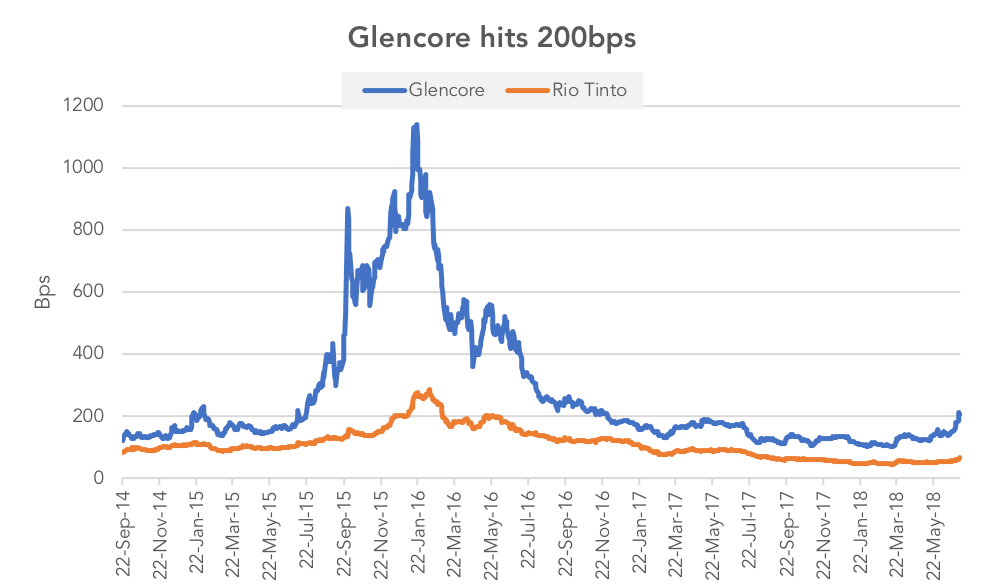
It’s not uncommon for a firm to have an association with an adjective. The description is often derogatory; for example, acquisitive companies are often said to be rapacious.
For Glencore, the commonly used adjective is “secretive”. This is no doubt due to the deliberately low profile of its CEO, Ivan Glasenberg, as well as its history as a private company. It was commonly referred to as “the biggest company you’ve never heard of”.
But there was a different perception in the CDS market. It was an established, highly liquid CDS name both prior to its IPO in 2011 and after. This underlines why a listing on a stock exchange, while important in raising the public profile of a company, is of secondary concern to fixed income investors – it’s all about the debt.
If one examines the credit history of Glencore, it appears to experience flare ups for relatively short periods before recovering and settling into its position as a high beta investment grade credit (it is consistently one of the widest names in the Markit iTraxx Europe).
In recent weeks the Swiss mining firm appears to have entered one of its phases of credit deterioration. Five-year CDS spreads widened from 135bps in mid-June to over 200bps on July 3, the first time it has breached this level since November 2016. IHS Markit liquidity shows the number of quotes rising and only a limited increase in the bid-ask spread, suggesting liquidity remains robust. Cash spreads have also widened.
What has prompted this latest outbreak of risk aversion? Glencore’s business interests in the Democratic Republic of Congo have created plenty of negative publicity over the last few months, culminating in the US Department of Justice issuing a subpoena demanding Glencore had over records relating to its compliance with money laundering and corruption laws. The prospect of a long investigation and potentially punitive fines naturally weighed on the firm’s credit outlook.
But it didn’t take long for Glencore to respond, and it did so in the form of a $1bn share buyback. A shareholder friendly action such as this can be credit negative – bondholders prefer cash to be used to reduce debt. However, when a firm is under pressure and it acts decisively to support the stock price it can also be viewed as a vote on confidence from management. This appears to be the case in this instance, as Glencore’s spreads rallied 5bps to trade at 190bps.
This is still significantly wider than where it was trading a few weeks ago, reflecting the considerable uncertainty surrounding the investigation. Glencore’s management have proven in the past that they can combat credit deterioration and maintain the investment grade rating. It will have to do so again, which won’t be easy amid headline risk from negative press coverage.
Contact: Gavan Nolan
Gavan.Nolan@ihsmarkit.com


Latest news

US Leveraged Loans Return 3.36% to Investors YTD
The Bloomberg US Leveraged Loan Index (Ticker: LOAN) returned 0.96% in August and has gained an additional 0.28% through September…

PE dry powder
The capital that is being raised is flowing overwhelmingly to the largest, most established managers.

Middle market debt held by BDCs vs High yield vs Treasury yields
The blue line represents the current dividend yield of the VanEck BDC Income ETF (BIZD), which stood at 11.7% as…