Markit Recap – 9/4/2017

Hurricanes impact reinsurers
Hurricane Harvey wreaked devastation across central America and the United States (particularly Texas and Louisiana), leaving an incalculable human cost.
But what of the economic cost? As usual with natural disasters it will be some time before it is possible to attach a firm number. But Moody’s estimate that the total cost in the US will be $51-$75bn, and if the higher number is reached then the economic damage will exceed the $69bn from hurricane Sandy in 2012.
Reinsurers obviously garner attention following natural disasters, though the oil industry has also been affected. But the typical pattern is that after a bout of modest spread widening, spreads quickly recover as investors recognize that the sector is generally well capitalized. That seems to be the case with hurricane Harvey. Much of the damage has been caused by flooding to personal property, and home insurance in the US doesn’t normally cover floods. It appears that the taxpayer will have to pick up a significant portion of the bill.
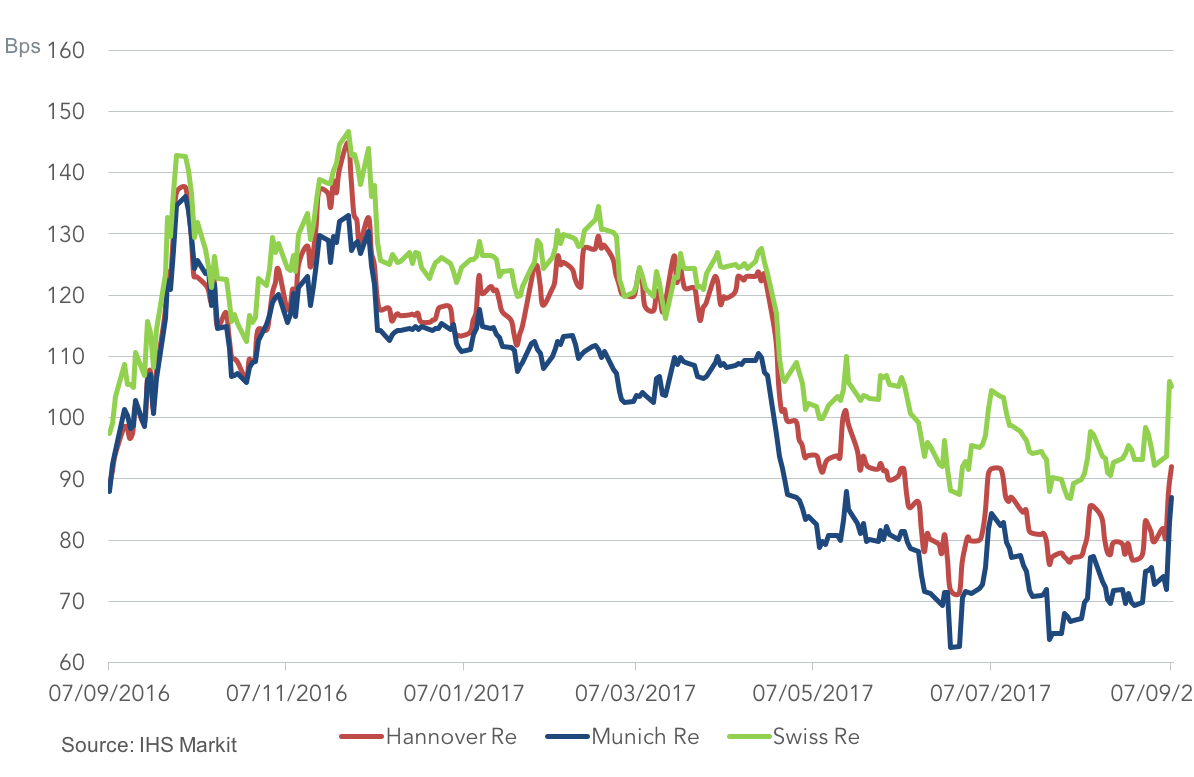
Unfortunately, the hurricanes didn’t end with Harvey. A category five storm in the shape of hurricane Irma is smashing though the Caribbean and possibly heading towards Florida. The prospect of massive wind damage to the Sunshine State has unsettled the reinsurance sector. Spreads in Swiss Re, Munich Re, Hannover Re have all widened in recent days due to the uncertainty on the eventual damage caused by Irma.
But it should be stressed that spreads in all three firms are still significantly tighter than where they started the year. Subordinated CDS in Swiss Re is trading at 105bps, 11bps wider over the last two days but 21bps tighter than 2016 year-end levels. It was a similar story with the other two credits.
It’s worth highlighting a quirk of the CDS market that European subordinated transactions are traded with Full Restructuring as standard, as opposed to Modified Modified Restructuring for other European corporates and financials. This is due to the long-dated subordinated liabilities of insurers. The 60-month deliverability limitation could leave subordinated contracts orphaned (no deliverable obligations), hence full restructuring (no maturity restriction) applies.
Past experience and knowledge of financial statements tells us that reinsurers are likely to remain resilient through this hurricane season, though it would be no surprise to see further volatility as the markets track Irma’s terrible path.
Contact: Gavan Nolan
Gavan.Nolan@ihsmarkit.com


Latest news

Top 50 BDCs Accounted for 75% of Nonaccrual Loan Cost in Q2’26
The 50 largest BDCs, on the basis of total debt investments as of the second quarter of 2026, accounted for 75% of the total aggregate reported value of nonaccrual debt at cost and fair value.

US private debt AUM ($B) by channel
In 2025 and the early part of 2026, the retail channel added AUM to the asset class at a much faster rate than institutional investors in both regions, with growth rates of 43.7% globally, 41.4% in the US, and 73. 1% in Europe through the beginning of 2026 compared with year-end 2024 figures.