
More investors say they are looking to deploy capital into the region, and the possibilities go beyond identifying new LPs.
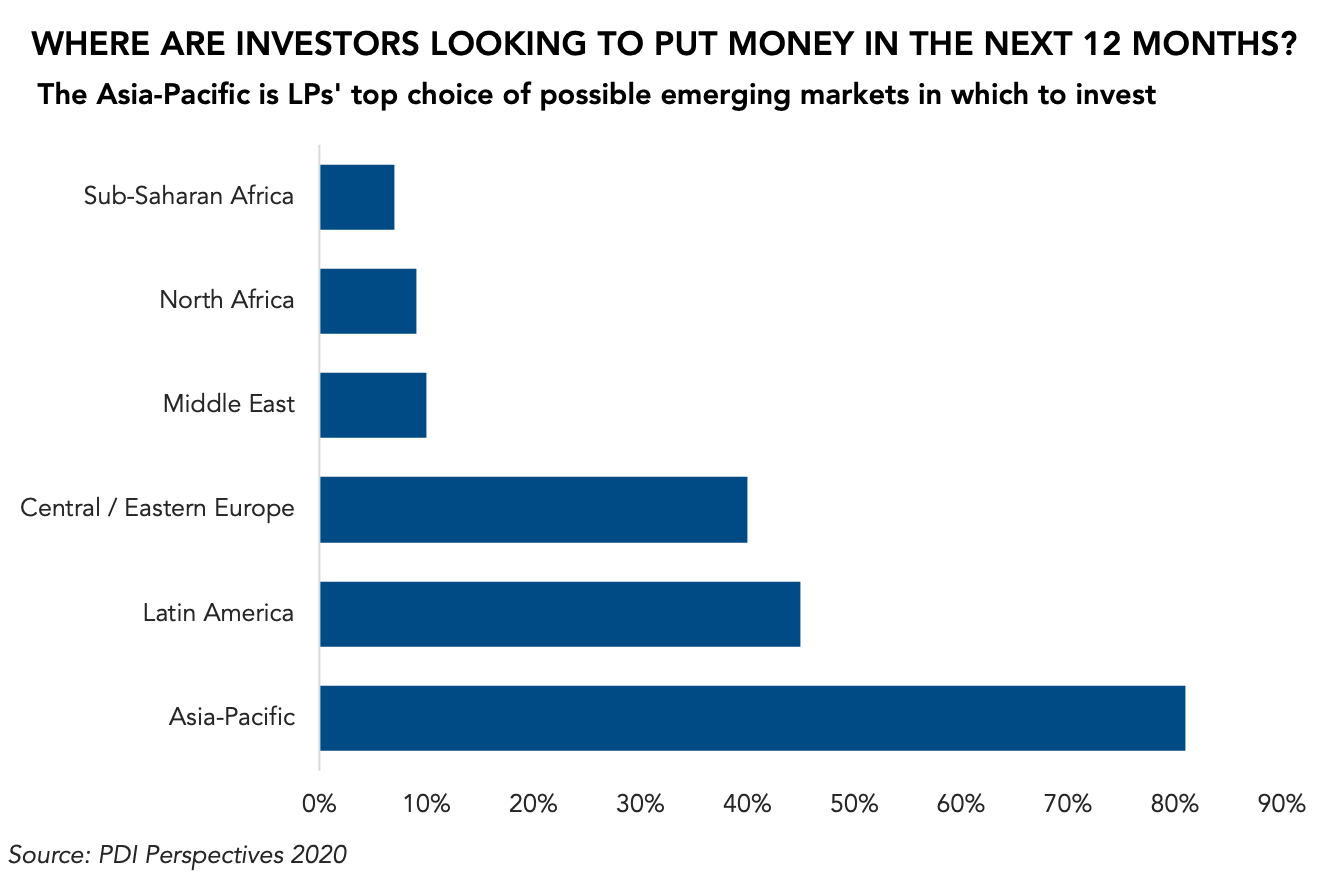
Not surprisingly, many alternative asset investors are considering the Asia-Pacific as one of the emerging markets in which they are likely to invest over the next 12 months, according to PDI Perspectives 2020.
More than eight in 10 investors said in our annual LP survey that they are considering expanding into that region, with the second-place answer being Latin America. At 45 percent, even the runner-up garnered significantly less support.
Now for a caveat: our questionnaire polls private equity, real estate and infrastructure investors as well. However, recent moves by managers have shown that a future exists that entails more than just GPs finding LPs in the region.
In just one example, Ares Management’s purchase of SSG this week is among the more high-profile ventures into the region, and chief executive Michael Arougheti has said that the firm plans to build out its private equity and real estate products there as well.
The amount of private equity money raised for Asia has been staggering in recent years. And of course, the banking system, the regulatory framework and insolvency laws vastly differ from North America. Even still, all the buyout money collected will need debt financing to back transactions.
Given LP appetite for the region and the funds that private equity vehicles have collected, there clearly exists an opportunity for managers.




Latest news

US leveraged loans returns turn negative in October
The Bloomberg US Leveraged Loan Index (Ticker: LOAN) has returned -0.26% this month through October 21, reducing its year-to-date return…

M&A activity begins to tick upward
In the third quarter of 2026, acquisition-linked loan volume across North America and Europe reached about $47 billion, up from $30.6 billion in Q2 and $29.5 billion a year ago.