Why private credit firms and their LPs should make ESG a priority

Environmental, social and governance policies provide another avenue of differentiation when all debt managers claim to have proprietary dealflow and the best downside protection.
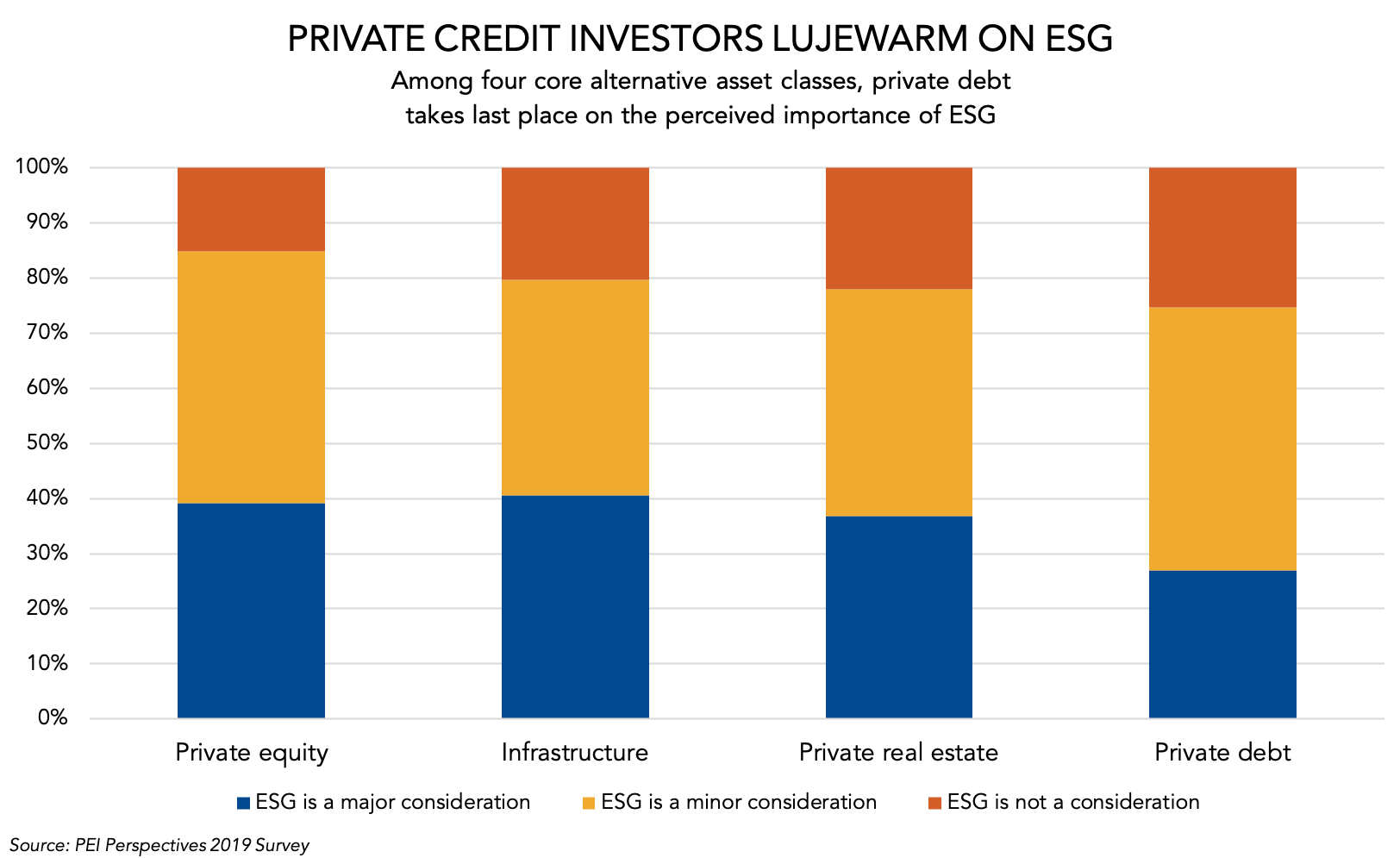
Among the four alternative asset classes PEI Media covers – private debt, private equity, private real estate and infrastructure – ESG means the least to investors in private debt, according to our annual investor survey PEI Perspectives 2019.
One-quarter of investors said that ESG is not a factor when looking at credit funds, while 48 percent said it is a “minor consideration” – the highest percentage among the quartet of investment strategies. Alternative lenders should take more of an interest in promoting ESG concerns though.
It’s understandable that ESG has yet to take hold in private debt the way it has among private equity, private real estate and infrastructure. After all, it is much easier to make an impact when you own a company, a building or infrastructure project.
You can run the business in an environmentally friendly way and promote social good, or back real asset projects that provide affordable housing, run on clean energy and the like. Plus, in these capital markets, a business that may have questionable ESG policies will still get a credit facility from someone, so why cede a deal to the competition?
In addition, private debt is essentially the youngest asset class in its institutionalisation.
Even with these factors, ESG should be a top concern for investors and credit managers; particularly with the seemingly constant stream of headlines sounding the alarm bell: the world has little time to tackle climate change before it’s too late.
Though private debt has the least influence compared to the other alternative asset classes, alternative lenders and their LPs should still do their part – whether it is only backing debt funds and businesses with solid ESG policies, adopting ESG investment standards or writing ESG goals into loan documents.


Latest news

Top 50 BDCs Accounted for 75% of Nonaccrual Loan Cost in Q2’26
The 50 largest BDCs, on the basis of total debt investments as of the second quarter of 2026, accounted for 75% of the total aggregate reported value of nonaccrual debt at cost and fair value.

US private debt AUM ($B) by channel
In 2025 and the early part of 2026, the retail channel added AUM to the asset class at a much faster rate than institutional investors in both regions, with growth rates of 43.7% globally, 41.4% in the US, and 73. 1% in Europe through the beginning of 2026 compared with year-end 2024 figures.