



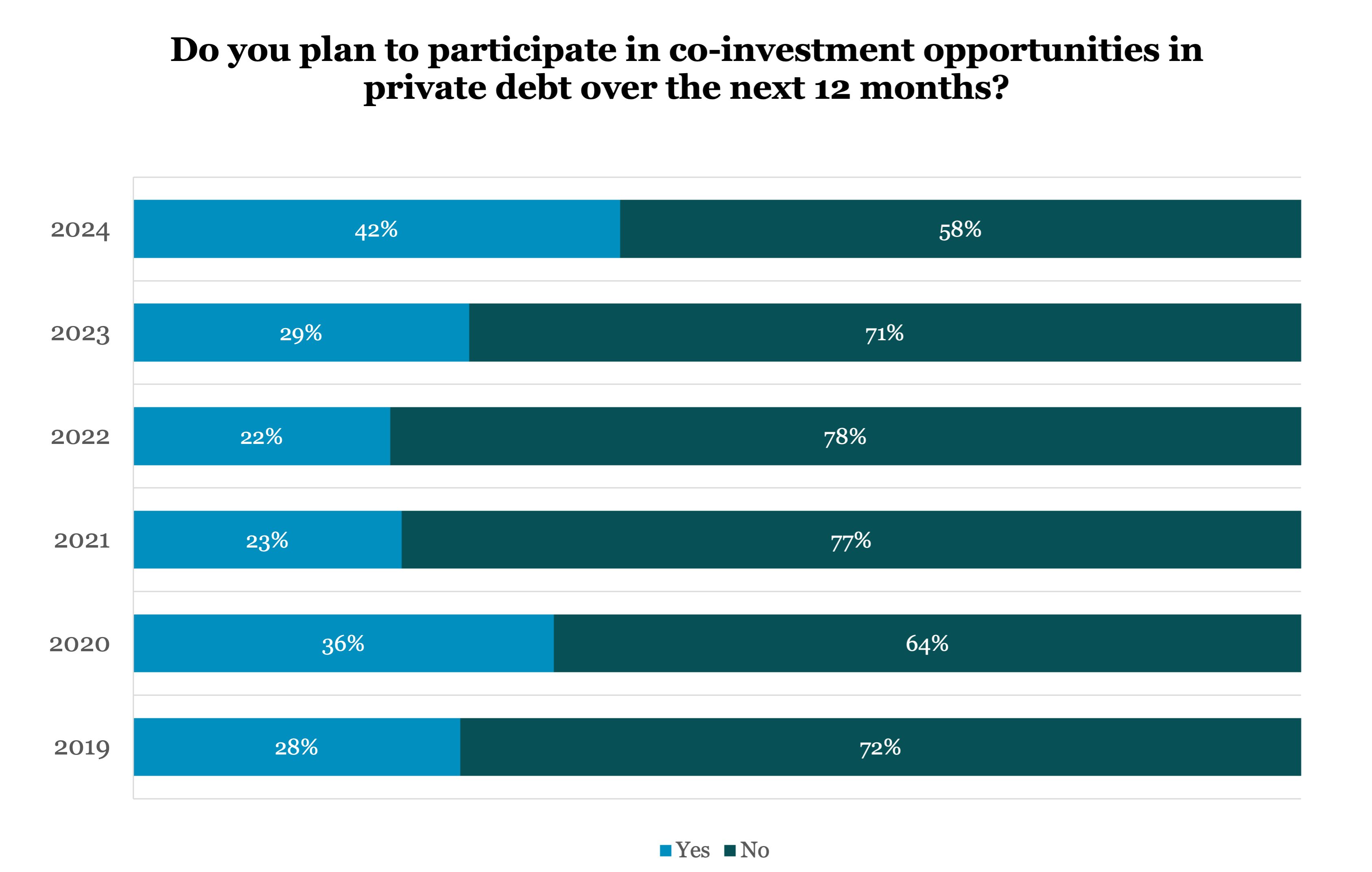
More than 40 percent of investors are now looking at co-investments in private credit – representing a big increase in appetite.
After many years of discussion, LPs are finally starting to benefit from co-investment opportunities in private credit. According to Private Debt Investor’s LP Perspectives 2024 study, more than four out of 10 investors plan to take advantage of co-investment opportunities in the next 12 months, the highest figure we have ever recorded, and the result of a gradual increase over time.
There are a number of reasons why co-investment has tended to be less widespread in debt than private equity. Peter Olds, partner at law firm Proskauer, says co-investment is probably less available in private credit than elsewhere because of the multi-strategy nature of the asset class. “If you’re a private equity GP and you have a restriction on how much you can put into any given deal, when you come across a deal that is twice as big, you have to raise the rest through co-investment,” he says.
“If you’re a credit manager, you likely have three other funds that can invest in the same deal, so you don’t need to look to co-investment so much.” Nevertheless, LPs like the chance to invest alongside managers, not least because the economics are typically much more attractive.
Co-investment activity over the years has matured greatly in terms of the number of GPs doing it and the way managers offer it to LPs, says Nick Warmingham, managing director, co-investments, at Cambridge Associates. Historically, co-investment was a post-close syndication exercise for GPs, but now they involve LPs in co-underwriting transactions and partway through the life of an investment, he told affiliate title Private Equity International.
“Now, for example, GPs will come to LPs partway through the life of an investment if there’s a transformational or significant add-on opportunity for a portfolio company.”
In the Perspectives survey, LPs say the primary issues that hinder their participation in co-investing opportunities are the speed required to conclude transactions, a shortage of staff and the risks involved. Only 28 percent say they are held back by a lack of available opportunities.




Latest news
Q2'26 BDC analysis shows additional 184 bps of nonaccruals at cost
In a universe of 173 business development companies, or BDCs, Octus identified a total of $9.5 billion of debt (at cost) in nonaccrual status reported in the second quarter of 2026, a slight decline of 5% from $10 billion in the first quarter of 2026.

Reading the Board
The story changes depending on which numbers you’re counting.
Private Credit Defaults 101: Different Numbers, Different Stories
In Season 2 of Billions, Bobby Axelrod takes his lawyer Orrin Bach to an empty Yonkers racetrack in the dead of night.