



The latest Proskauer study suggests loans are demonstrating impressive resilience but there should be no room for complacency.
Defaults may not provide a conclusive picture of the amount of stress in the private credit universe but they’re still one of the best – and most commonly referenced – measurements that we have.
So what does the current default rate tell us about the state of the market today? According to a respected study from New York-based law firm Proskauer – whose Private Credit Default Index tracks senior-secured and unitranche loans in the US – there doesn’t appear to be too much to worry about.
The index revealed a default rate of just 2.42 percent for the first quarter of 2025, slightly lower than the 2.67 percent figure from the fourth quarter of 2024. Not the lowest the rate has even been, but also far from the highest.
Stephen Boyko, partner and co-founder of Proskauer’s private credit group, said: “The latest default rate continues to reflect a stable and resilient private credit market [because] credit fundamentals remain strong and lenders continue to show discipline in underwriting and portfolio management.”
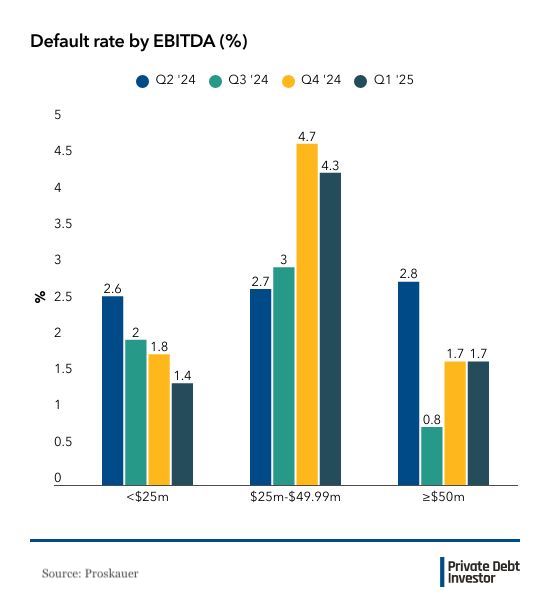
In the first quarter, the private credit default index encompassed 786 loans representing a principal amount of $148.6 billion, divided into three EBITDA categories (below $25 million, between $25 and $50 million, equal to or above $50 million). Across all three bands the default rate was less than or equal to that of the quarter before.
For the smallest EBITDA group, the rate has fallen quarter-to-quarter for the past three quarters.
So, nothing for borrowers and lenders to fear? With the tariff impact only just being felt, interest rates remaining high and the threat of possible recession on the horizon, that would be an assertion too far.
Patrick Warren, vice president of research at MSCI, recently noted that loan valuations deteriorated further in 2024, with 50 percent write-downs becoming more common.
“These deeper write-downs suggest that a growing number of borrowers are really getting squeezed by a combination of sustained elevated interest rates and an uncertain growth outlook, and these are the types of loans at the greatest risk of sliding into restructuring, barring a turnaround.”
So far, no need for panic. That doesn’t necessarily mean things won’t get uncomfortable at some point.


Latest news

European mid-market direct lending margins face steady compression since 2024
European mid-market direct lending margins have seen consistent compression over recent years but recorded a slight increase in the second quarter of 2026…

US leveraged loan issuance rebounds in September
Following three consecutive months of declining issuance, the US leveraged loan market has reversed course in September. Approximately $48.7b of…

Reversion to the Mean
Climbing toward the average is a very different story than surpassing it.