



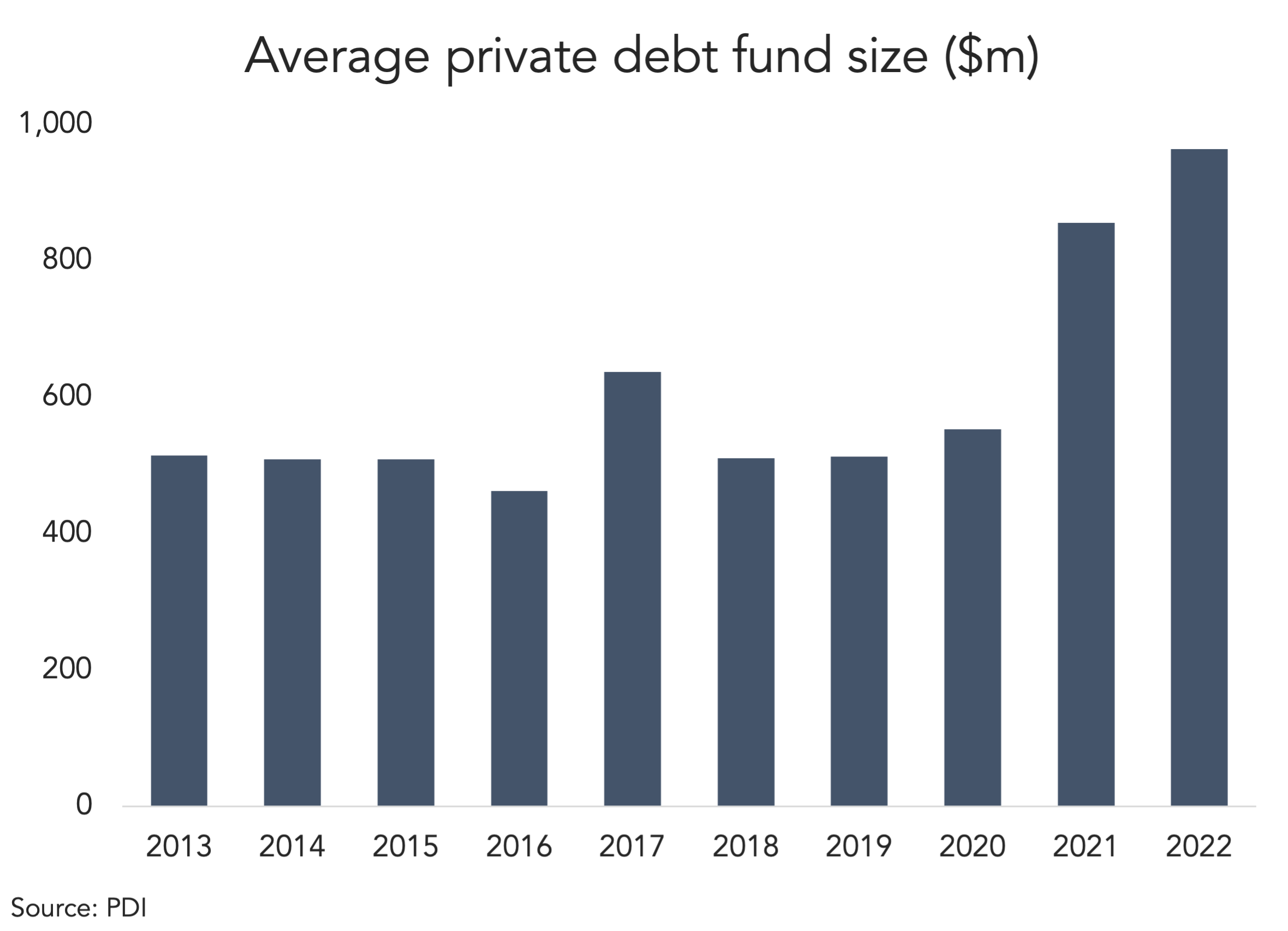
Our recent review of the asset class’s progress over the last ten years noted how the average size of funds keeps on growing.
One of the findings of our recent Decade issue was the rapid advance in the sizes of private debt funds. Increasing concentration of fundraising among the top managers and decreasing vehicle launches means the average fund size has soared in recent years.
While the average fund size was typically around $500 million between 2012 and 2020 (with a notable exception in 2017 when it shot up over $600 million), 2021 and 2022 have seen the average size advance rapidly to $856 million and $964 million, respectively.
What the Decade issue also noted was that North America has long been the most developed market for private credit and was a significant player before the global financial crisis.
Even today, much more capital is raised for North American vehicles than European vehicles. Particularly since the covid-19 crisis the US has been able to reassert itself, while Europe has struggled during a period of sluggish economic growth marked by an energy crisis and the war in Ukraine.
The data also reveals that beyond the Western markets, private credit has yet to take off. Activity is fairly low in the Asia-Pacific region, and it is virtually unheard of in the developing world. Over the next decade, it will be interesting to see whether that changes and private debt lays claim to being a truly global asset class.
(Past performance is no guarantee of future results.)



Latest news

US Leveraged Loans Return 3.36% to Investors YTD
The Bloomberg US Leveraged Loan Index (Ticker: LOAN) returned 0.96% in August and has gained an additional 0.28% through September…

PE dry powder
The capital that is being raised is flowing overwhelmingly to the largest, most established managers.

Middle market debt held by BDCs vs High yield vs Treasury yields
The blue line represents the current dividend yield of the VanEck BDC Income ETF (BIZD), which stood at 11.7% as…