
Investors say they are interested in the strategy, but few are putting their money where their mouth is.
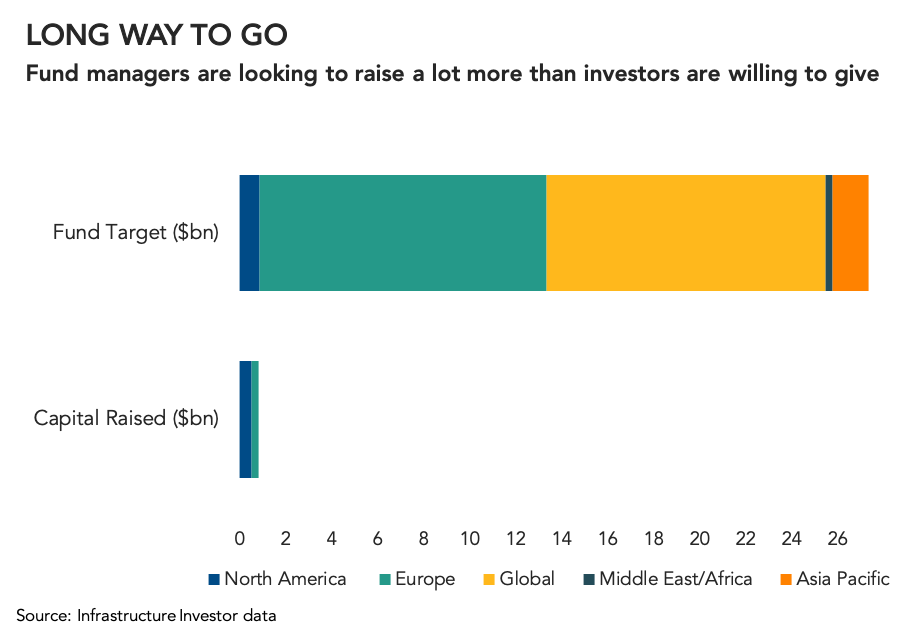
Infrastructure debt fundraising has hit a lull so far in 2019 as the market enters the second half of the year. Infrastructure debt fund managers have only held final closes on a little more than $800 million so far this year across two funds, in comparison to the $3.2 billion across four funds that had been raised at this point last year.
This number looks even bleaker when stacked next to the amount of capital being sought out for infrastructure debt managers. According to data from sister publication Infrastructure Investor, the funds in market are currently seeking more than $27 billion.
However, the lull may be temporary, as the strategy is viewed as favourable by investors and there is still half of a year for fundraising activity.
PEI Perspectives 2019, a limited partner survey conducted by sister publication Private Equity International, found that 27 percent of investors were looking to increase their allocation to infrastructure. Within that, 92 percent of participants wanted to either increase their allocation to infrastructure debt specifically or keep it the same, with only 8 percent looking to decrease it.
Notable infrastructure debt funds in market currently include Westbourne Capital’s Westbourne Infrastructure Debt Opportunities Fund II, which is targeting $3 billion, Global Infrastructure Partners’ GIP Spectrum Fund, targeting $1.5 billion, and AXA Investment Manager’s AXA European Infra Senior I, which is seeking €1.5 billion.



Latest news
Top 50 BDCs Accounted for 75% of Nonaccrual Loan Cost in Q2’26
The 50 largest BDCs, on the basis of total debt investments as of the second quarter of 2026, accounted for 75% of the total aggregate reported value of nonaccrual debt at cost and fair value.

US private debt AUM ($B) by channel
In 2025 and the early part of 2026, the retail channel added AUM to the asset class at a much faster rate than institutional investors in both regions, with growth rates of 43.7% globally, 41.4% in the US, and 73. 1% in Europe through the beginning of 2026 compared with year-end 2024 figures.