
When is senior debt really senior debt? A new report into so-called ‘priming’ brings this into question.
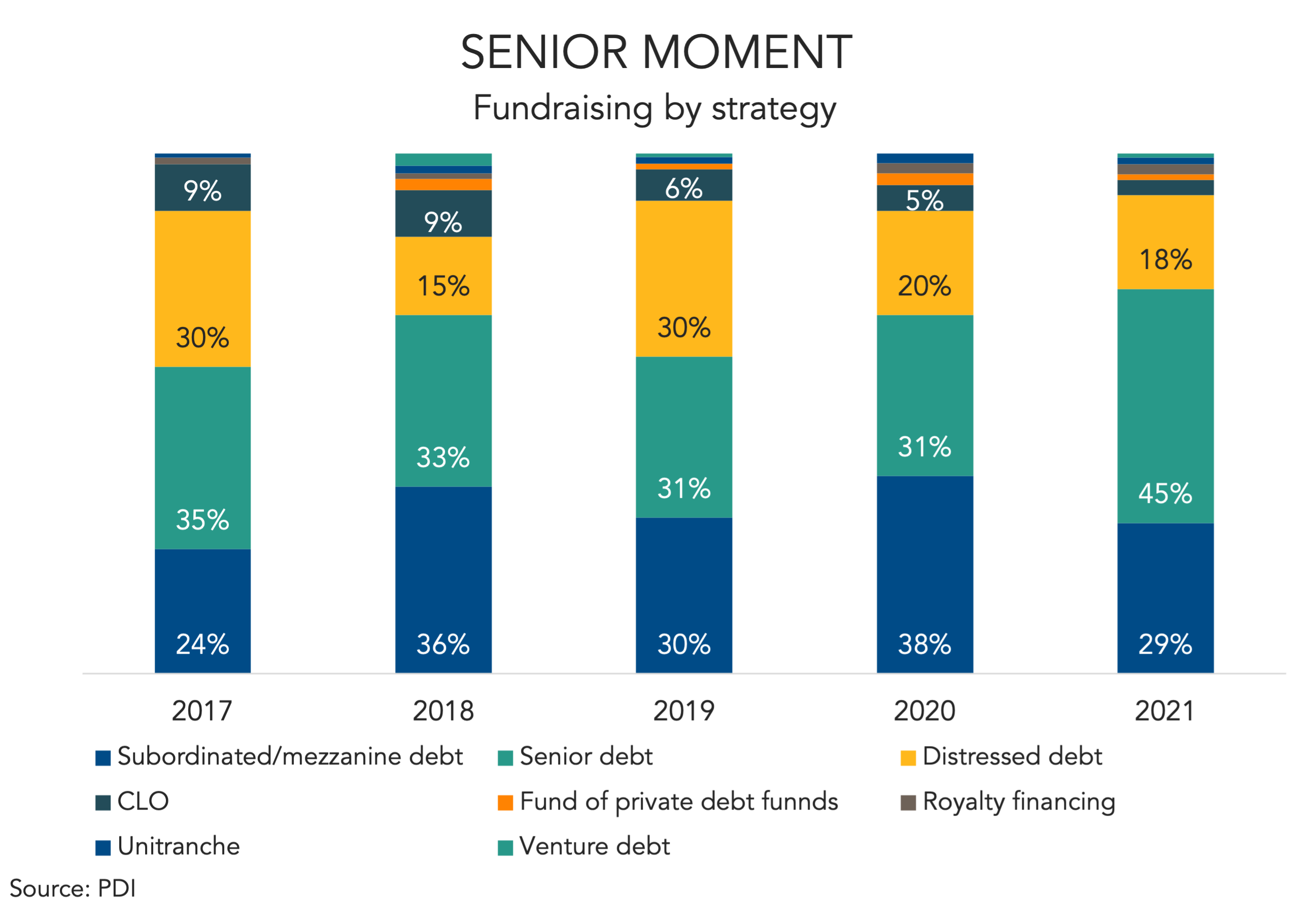
Last year saw senior debt shoot up in popularity, accounting for a record 45 percent of total private debt fundraising (see chart). But is senior debt really senior? It may sound like an odd question, but it’s one that’s being asked more often as a result of so-called “priming” in the European leveraged finance market.
The “priming” trend has been noted by S&P Global Ratings, which in an article published earlier this week – The Shifting Seniority of Senior Debt – described how some senior debt holders are discovering they’ve lost their priority status in the capital structure due to the introduction of new “super senior” debt.
The implications of this can be serious since a large tranche of super senior debt sitting above the senior debt “is likely to materially reduce the amount of cash that senior debt holders recover” in the event of a default.
This is a potentially significant issue with default rates being seen as likely to rise. Senior debt recovery rates in Europe have traditionally averaged about 73 percent, with the US figure at 79 percent. In recent US examples of super senior debt, the average amount of debt introduced ahead of the original first lender was 21 percent of the total debt structure.
Despite anecdotal reports of senior debt holders being taken by surprise by this development, S&P points out that in most cases pre-approval for the introduction of super senior debt is contained in intercreditor agreements.
The wording, says S&P, will often be similar to the following: “The creditors hereby acknowledge and agree that the debtors…shall be permitted…to incur or have incurred incremental borrowing liabilities…which in any case are intended to rank pari passu with or in priority to any existing liabilities and/or share pari passu with or in priority to an existing security.”
The takeaway is a well-known one: always pay close attention to the small print!
(Past performance is no guarantee of future results.)




Latest news

Middle market debt held by BDCs vs High yield vs Treasury yields
The blue line represents the current dividend yield of the VanEck BDC Income ETF (BIZD), which stood at 11.7% as…

LevFin Issuance Slows Across Products in August; DCM Remains a Bright Spot
The leveraged capital markets business continued to decelerate from just about every aspect, even for August standards. Overall issuance (including…