


Preqin Private Debt Intelligence – 6/27/2016

Credit Hedge Fund Performance in 2016 YTD
The first months of 2016 were characterised by continued market volatility, and credit-focused hedge funds recorded losses across all sub-strategies in January and February. However, as global turbulence has calmed moving into Q2, all sub-strategies have seen improved performing and posted three consecutive months of gains from March to May.
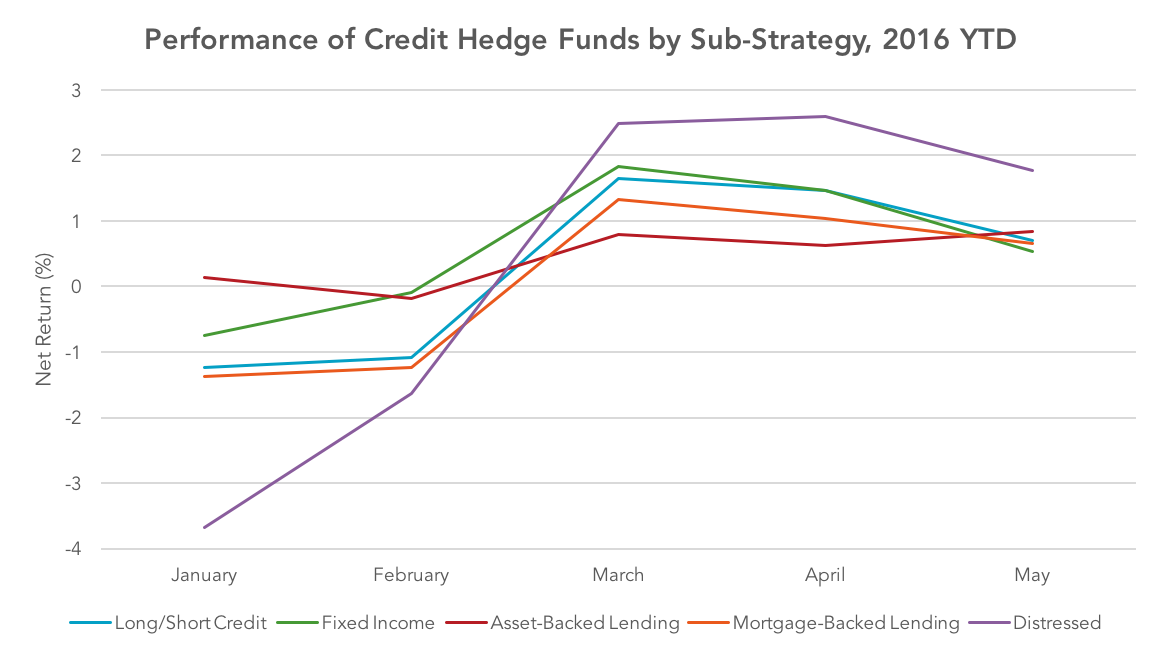
Distressed hedge funds have experienced the greatest volatility of any credit strategy, suffering the heaviest losses in January (-3.68%) and February (-1.63%), before returning the highest gains through March (+2.48%), April (+2.59%), and May (+1.77%). Given their reliance on capitalising on macro-economic events, it was perhaps little surprise to see distressed funds struggle early on in the year. Conversely, asset-backed credit hedge funds have performed consistently, with returns not exceeding the 0.84% seen in May nor falling below February’s 0.18% losses. Asset-backed hedge funds saw the highest overall returns of any credit sub-strategy through 2015 as they made gains of 7.33%; this consistency in the early part 2016 suggests that funds are once again successfully hedging against widespread swings in value seen across global markets.
Long/short credit vehicles and mortgage-backed lending hedge funds have seen highly correlated returns in the first five months of the year, perhaps suggesting that the larger relative size of these industries makes them prone to following broader market trends. Mortgage-backed hedge funds saw the losses of 1.37% in January, slightly below the 1.24% losses incurred by long/short credit funds. Performance of both strategies rose above 1% in March to reach 1.33% and 1.64% respectively, but since then gains have diminished, and long/short credit funds saw performance of 0.70% in May, while mortgage-backed lending funds gained 0.66%.
The rest of 2016, seems likely to be dominated by ongoing volatile situations in both the US and Europe. The US presidential election campaign will continue until November, while negotiations on Britain’s exit from the EU is likely to provoke extended uncertainty throughout the region. As such, it is too early to cast predictions for credit funds over the remaining six months. Nonetheless, the ability of most credit strategies to provide uncorrelated returns through the year so far means that they may become increasingly favourable among investors seeking safe havens.
Contact: William Clarke
william.clarke@preqin.com



Latest news

US Leveraged Loans Return 3.36% to Investors YTD
The Bloomberg US Leveraged Loan Index (Ticker: LOAN) returned 0.96% in August and has gained an additional 0.28% through September…

PE dry powder
The capital that is being raised is flowing overwhelmingly to the largest, most established managers.

Middle market debt held by BDCs vs High yield vs Treasury yields
The blue line represents the current dividend yield of the VanEck BDC Income ETF (BIZD), which stood at 11.7% as…