


Private Debt Intelligence – 4/3/2017

Placement Agents and Private Debt
Placement agents servicing the private debt industry have been expanding their services to keep up with the development of the asset class. In addition to their traditional role of connecting fund managers with suitable investors, placement agents increasingly offer ongoing investor relations assistance, and services to help fund managers comply with regulatory standards.
Placement agent usage has increased in recent years: 43% of private debt vehicles closed in 2015 used a placement agent, compared to 59% of funds closed in 2016. The proportion of vehicles that employ a placement agent depends on several factors, including the number of new managers moving into the space and the areas in which placement agents choose to operate in a given year.
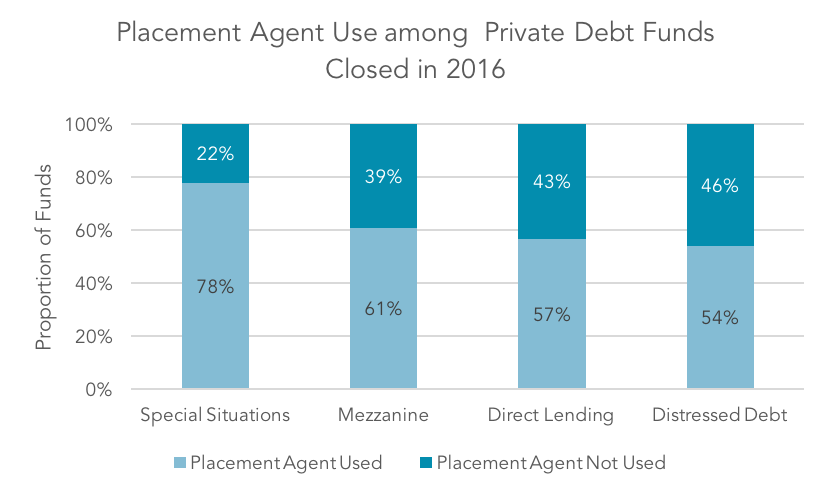
Among private debt funds closed in 2016, special situations vehicles were the most likely of all debt types to use a placement agent, with nearly four-fifths (78%) engaging their services during the fundraising process. This is not surprising considering the niche nature of special situations investing, which can make it harder for managers to find consistent investors. By contrast, distressed debt funds saw the lowest rate of placement agent use (54%), while direct lending (57%) and mezzanine (61%) funds also employing placement agents less frequently than special situations funds.
A significant 71% of managers that closed funds in 2016 and used a placement agent are based in North America. Europe-based managers represent the remaining 29%, but no Asia and Rest of World-based firms that closed vehicles in 2016 used a placement agent.
As private debt fundraising generally, and special situations fundraising in particular, are currently seeing an uptick in the number of funds coming to market, it is likely that the use of placement agents will continue to increase through 2017. Their particular appeal to emerging fund managers and niche vehicles means that a surge in use of an agent is indicative of the continued expansion and diversification of the private debt asset class.



Latest news

US Leveraged Loans Return 3.36% to Investors YTD
The Bloomberg US Leveraged Loan Index (Ticker: LOAN) returned 0.96% in August and has gained an additional 0.28% through September…

PE dry powder
The capital that is being raised is flowing overwhelmingly to the largest, most established managers.

Middle market debt held by BDCs vs High yield vs Treasury yields
The blue line represents the current dividend yield of the VanEck BDC Income ETF (BIZD), which stood at 11.7% as…