
Download PitchBook’s Report click here.
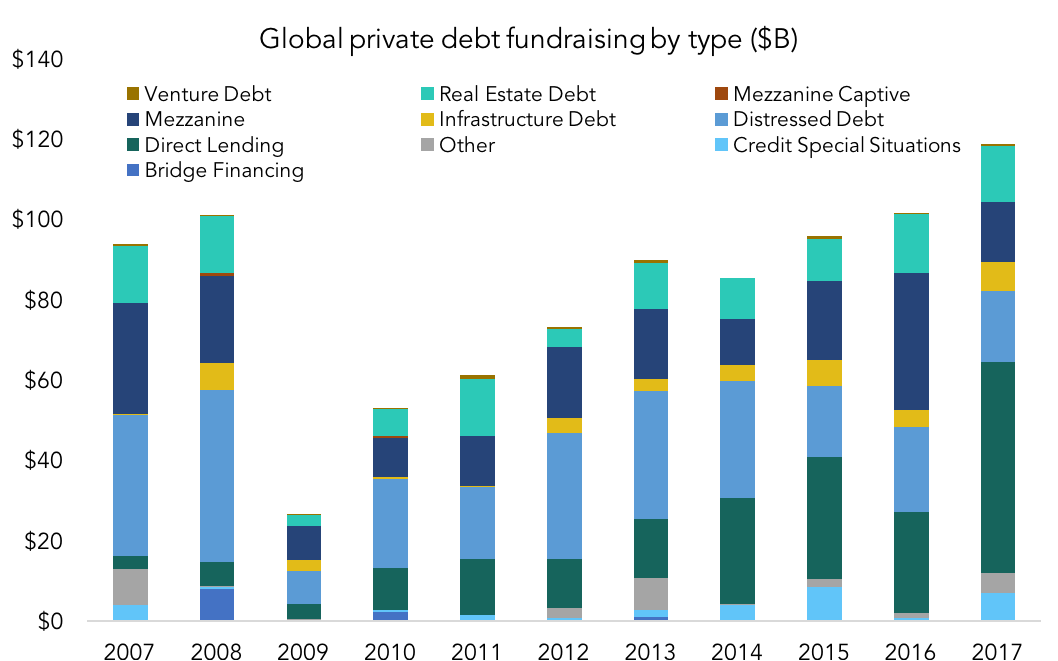
Following the financial crisis, raising funds for private debt vehicles has mirrored—and in some cases exceeded—the exponential growth of the larger private capital market. 2017 was a record year in capital commitments, which totaled more than $118 billion globally. Of course, the private debt market can be sliced into a number of sub-strategies, each with their own contribution to the capital structure. The explosion in private debt fundraising (graphed above) has usually been credited to quantitative easing, which pushed public market yields down to razor-thin margins. Institutional investors looking to revive “normal” credit returns, turned to private debt in droves. There’s some truth to that, but the bigger engine was new financial regulations put in place by Dodd-Frank and Basel III, which in their own ways both stymied the lending capabilities of big banks, leaving a crater-sized hole in the credit market.
The other major influence on the private debt market was the private equity industry itself. What goes on in the PE market has a large impact on what goes on in the private debt market. The two go hand-in-hand in many ways, and momentum in one asset class helps fuel momentum in the other. As the supply of private debt has ballooned to record levels, the result has been, what else?, increased competition on terms and pricing. Cov-lite loans are at unprecedented levels, and add-backs have increased in usage to make issuers seem more creditworthy. On the other side of the coin, lenders and LPs are in a riskier position today—fewer protections and lower rates could ultimately mean lower returns for general debt funds, which could mean even more opportunity for niche players like distressed debt or turnaround funds.
Contact: Alex Lykken
alex.lykken@pitchbook.com


Latest news
Top 50 BDCs Accounted for 75% of Nonaccrual Loan Cost in Q2’26
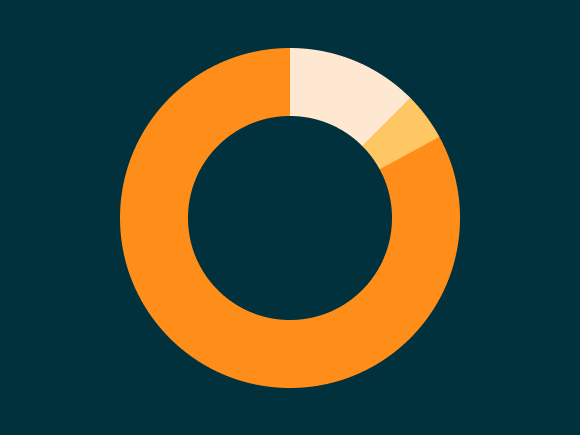
The 50 largest BDCs, on the basis of total debt investments as of the second quarter of 2026, accounted for 75% of the total aggregate reported value of nonaccrual debt at cost and fair value.

US private debt AUM ($B) by channel
In 2025 and the early part of 2026, the retail channel added AUM to the asset class at a much faster rate than institutional investors in both regions, with growth rates of 43.7% globally, 41.4% in the US, and 73. 1% in Europe through the beginning of 2026 compared with year-end 2024 figures.