



What is in store for US private equity in 2017?
After a high-water mark for US private equity activity in 2015, last year experienced a significant slowing in not only the number of closed deals but also total deal value, the latter ameliorated by a bevy of blockbuster transactions. This was driven in part by the progression of a typical investment cycle, wherein after a steady ramp-up in dealmaking the market attracts more and more firms looking to cut deals and consequently becomes pricier. External conditions like the relative attraction of the PE asset class amid the global financial landscape didn’t assuage matters for PE fund managers, who enjoyed plenty of interest from limited partners and responded in kind, amassing significant hoards of dry powder that kept upward pressure on valuations in auctions. A coinciding M&A boom also led to higher valuations at the upper end, as players in more traditional industries sought acquisitive routes to growth. Accordingly, total deal value remained robust but PE dealmakers slowed their pace throughout 2016, responding to valuations, lack of worthwhile targets, overheated competition or shaky growth prospects in certain arenas.
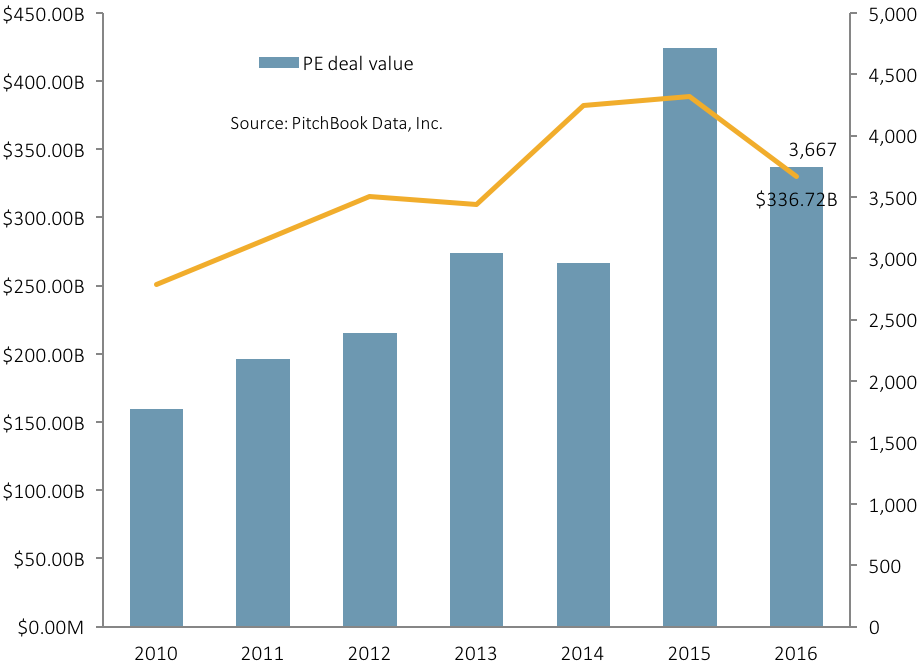
So where does this leave the US PE industry, on the cusp of 2017? Investors will at the very least just maintain their current investing pace, as public market comparables seem to show no sign of slowing anytime soon and many sectors in the US economy are still sound, particularly relative to the global scene. The case of fundraising is curiouser, to borrow a phrase, as there are significantly countervailing factors: the overhang of capital raised and investors’ demand for exposure to PE. Everything else equal, it’s likeliest that fundraising will continue in an even more targeted fashion, resulting in a slight decrease in vehicles closed but significant success in hitting targets. Last but not least, PE-backed exits should continue at a decent clip, but as the M&A boom cycles downward and IPO prospects remain cloudy, their frequency will gradually decline, or in a moderately more optimistic scenario, flatline.
Contact: Garrett Black
garrett.black@pitchbook.com



Latest news

US Leveraged Loans Return 3.36% to Investors YTD
The Bloomberg US Leveraged Loan Index (Ticker: LOAN) returned 0.96% in August and has gained an additional 0.28% through September…

PE dry powder
The capital that is being raised is flowing overwhelmingly to the largest, most established managers.

Middle market debt held by BDCs vs High yield vs Treasury yields
The blue line represents the current dividend yield of the VanEck BDC Income ETF (BIZD), which stood at 11.7% as…