



Download PitchBook’s Report click here.
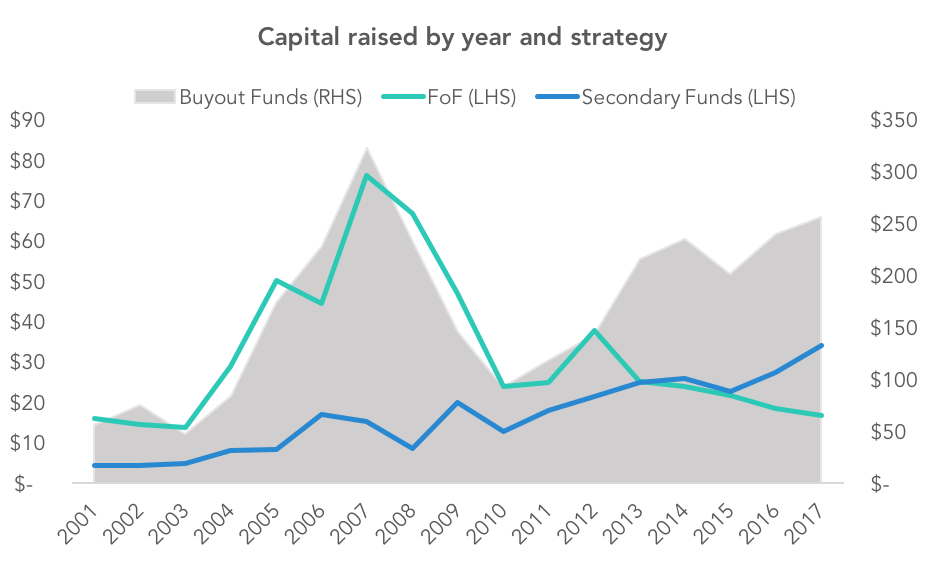
Are fund-of-funds obsolete? It’s a question that’s been asked over the years, but one that is taking on more urgency as the numbers continue to slide down and to the right. FoF fundraising declined a fourth straight year in 2016 and is on track for a fifth consecutive decline this year. It’s hard to blame a poor environment overall, as fundraising across other private strategies, including secondaries, has surged to pre-crisis levels or higher. The FoF model is distinctly unpopular at the moment.
The primary criticism of funds-of-funds, which still holds, is the extra layer of fees charged for their services on top of primary manager fees. Fund-of-funds have always been expensive, but the market has tolerated that extra layer given the convenience factor afforded to the LPs that back them. Reporting requirements are complicated, relationships with primary managers are built-in, and unpredictable capital calls are taken care of. Those are all persuasive factors for inexperienced LPs, and those peripheral (and often overlooked) benefits have helped sustain the FoF model, despite years of underperformance. But those points hold less weight today, as institutional investors continue to become more sophisticated and seek out higher returns from private equity, which has taken on a “savior” role for underfunded pensions. In this environment, that extra layer of fees and persistent underperformance have become harder to justify.
The number of LPs in need of FoFs has become much smaller recently. Several large asset managers—Goldman Sachs is an example—have built in-house “manager selection” programs that mimic the FoF model; inexperienced LPs that have historically gravitated toward FoFs have more (and often cheaper) options available today. Many of those new options have strayed from the FoF habit of simply re-upping with existing managers, an iffy strategy given the dynamism of the PE market. First-time managers are usually shunned by the FoF crowd, despite evidence that debut funds have historically outperformed follow-on funds. In a sense, choosing PE managers is similar to picking stocks and bonds, but with the added complexities of key-man provisions, succession planning and workplace culture.
It’s safe to say the FoF is past its heyday, and may be on the verge of dying altogether. To regain relevance, it will need to start reshaping its approach before its client base becomes even smaller than it is today.
Contact: Alex Lykken
alex.lykken@pitchbook.com



Latest news

With inflation running hot, rate hike expectations strengthen
A hotter-than-expected inflation reading has renewed expectations for near-term Federal Reserve tightening. The Consumer Price Index rose 0.6% month-over-month, pushing…

Open Tab
Leveraged loans keep running up a tab. Senior direct lending already knows what it owes.
