



Download PitchBook’s 2017 Annual US PE Middle Market Report click here.
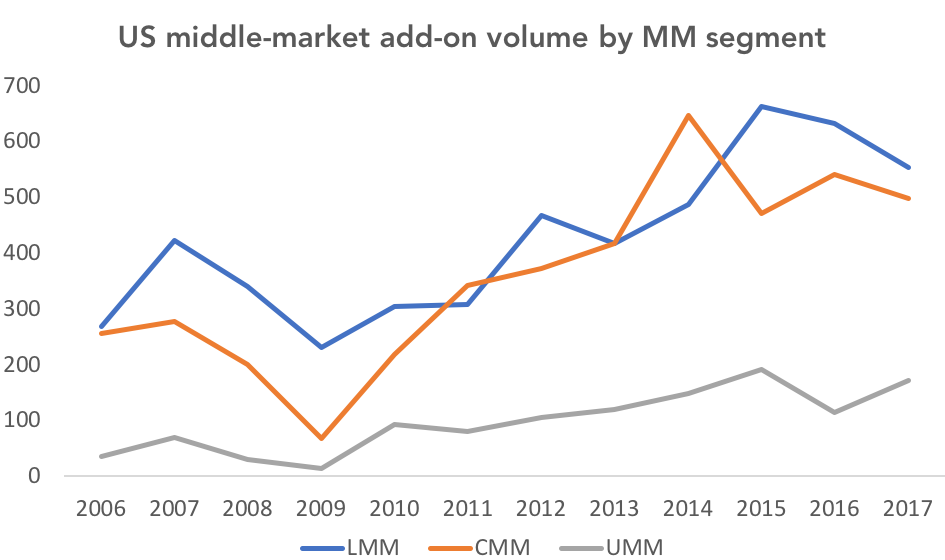
The buy-and-build model is popular in the PE industry. Investors’ appetite for add-ons stretches back about a decade, but most of the increase has taken place in the middle market, specifically at the lower end. Following the financial crisis, lower- and core-middle-market add-on activity exploded by volume, peaking in counts in 2015 and 2014, respectively. Upper-middle-market activity accelerated just as strongly, increasing by over 1,000% between 2009 and 2017. It should be noted, though, that UMM add-ons were a rarity in 2009 (only 14 all year that year), making last year’s 171 add-ons seem like a much higher surge in percentage terms.
The “buy-and-build” approach has become so common that it’s now considered an integral part of the buyout market. That wasn’t always the case—in years past, PEGs relied heavily on financial engineering and arbitrage opportunities to earn their massive payouts. As the industry grew in size and the market became much more competitive, leverage and arbitrage were suddenly far less reliable tools in the toolkit. The financial crisis was a turning point for private equity, insofar as new ideas and approaches were needed—quickly—to outperform the market. The industry turned to add-ons, which in many cases involved much smaller companies historically overlooked by investors. Portfolio companies large and small require significant amounts of operational improvements to make successful investments—the bias toward large targets was justifiable in that sense but, post-2009, didn’t offer the same potential as they once did. Smaller companies lacking managerial expertise and capital quickly garnered PE’s attention, as the accompanying chart makes clear. Fast-forward ten years, today’s investors are often expected to have a list of roll-up targets ready to go before the platform is even acquired, and if the platform company isn’t impressed, another PE firm might be waiting in the wings with a better roll-up plan. No longer ignored, smaller companies now play a significant, sometimes crucial role in the fortunes of investors. What a difference a decade makes.
Contact: Alex Lykken
alex.lykken@pitchbook.com




Latest news

The Recovery Shot
Trouble off the tee doesn’t always translate to trouble on the scorecard.
Q2'26 BDC analysis shows additional 184 bps of nonaccruals at cost
In a universe of 173 business development companies, or BDCs, Octus identified a total of $9.5 billion of debt (at cost) in nonaccrual status reported in the second quarter of 2026, a slight decline of 5% from $10 billion in the first quarter of 2026.
Private Credit Defaults 101: Scrambling for Par
Seve Ballesteros won four majors in the 1980s despite being, by his own admission, one of the wildest drivers of the golf ball on tour.