



Download PitchBook’s Report here.
TPG Capital, one of the largest PE firms to retain its partnership structure, flirted with the idea of going public this year. Many of its peers are already publicly traded—Blackstone, KKR and Apollo, to name a few. But since going public, their shares haven’t performed very well, prompting TPG (according to reports) to scuttle its IPO plans altogether. They have reason to: the lesson that Blackstone, Apollo and KKR have learned is that the public markets don’t do value the private equity business the way that they do. That may change over time, but up until now, equity analysts haven’t seen eye-to-eye on PE stock valuations, perhaps because they cover PE as a subset of the broader financial services industry, where different rules apply.
Rather than going public, TPG is staying private for now, but with the additional possibility of raising outside capital through a stake sale instead. Quietly, GP stake sales have become one of the most intriguing developments to hit the PE industry in recent years. Our latest analyst note dives into the subject, which deserves more attention if and when the fundraising boom dies down. In years past, GP stake sales were interpreted as a way for PE executives to cash out of their firms, where a large chunk of their wealth was tied. Whether the cynical take was true or not, the motivations to sell GP stakes have changed, the biggest of which is strategy diversification. Proceeds from recent stake sales have been used as seed funding for new credit and real estate strategies. On the other side of the coin, some large managers are buying stakes in smaller GPs to buy diversification of their own. TPG recently made a minority investment in NewQuest Capital, an Asia-based secondaries firm.
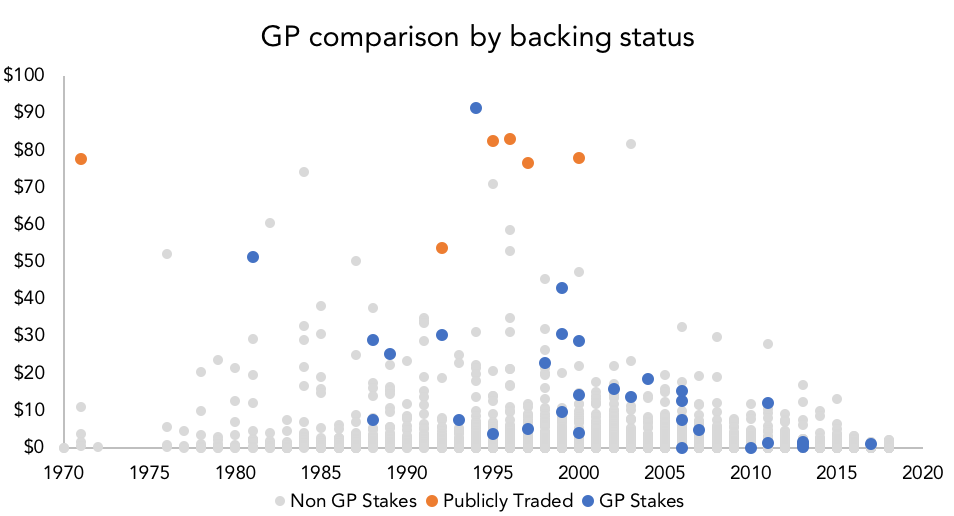
Still in its early stages, GP stakes investing is, for now, confined to well-known firms, but is already hitting record levels. “Nobody ever got fired for investing in Blackstone,” goes the old saying. Taking that to heart, most GP stakes investments have involved older and larger firms with long and successful track records, as the accompanying chart shows. Those same firms are also the ones that typically have the least trouble raising funds. That prompts the question of whether outside investors will have an effect on future fund performance, since investing in the GPs themselves hinges on fee generation.
Contact: Alex Lykken
alex.lykken@pitchbook.com


Latest news

PIK Your Next Adventure
Every amended PIK loan hits the same crossroad. Not everyone ends up at the same destination.

Top 50 BDCs Accounted for 75% of Nonaccrual Loan Cost in Q2’26
The 50 largest BDCs, on the basis of total debt investments as of the second quarter of 2026, accounted for 75% of the total aggregate reported value of nonaccrual debt at cost and fair value.
Private Credit Defaults 101: Beyond the Noise
Like any good school year, this series went by fast. But unlike the end of the year, we’re not out for the summer.