



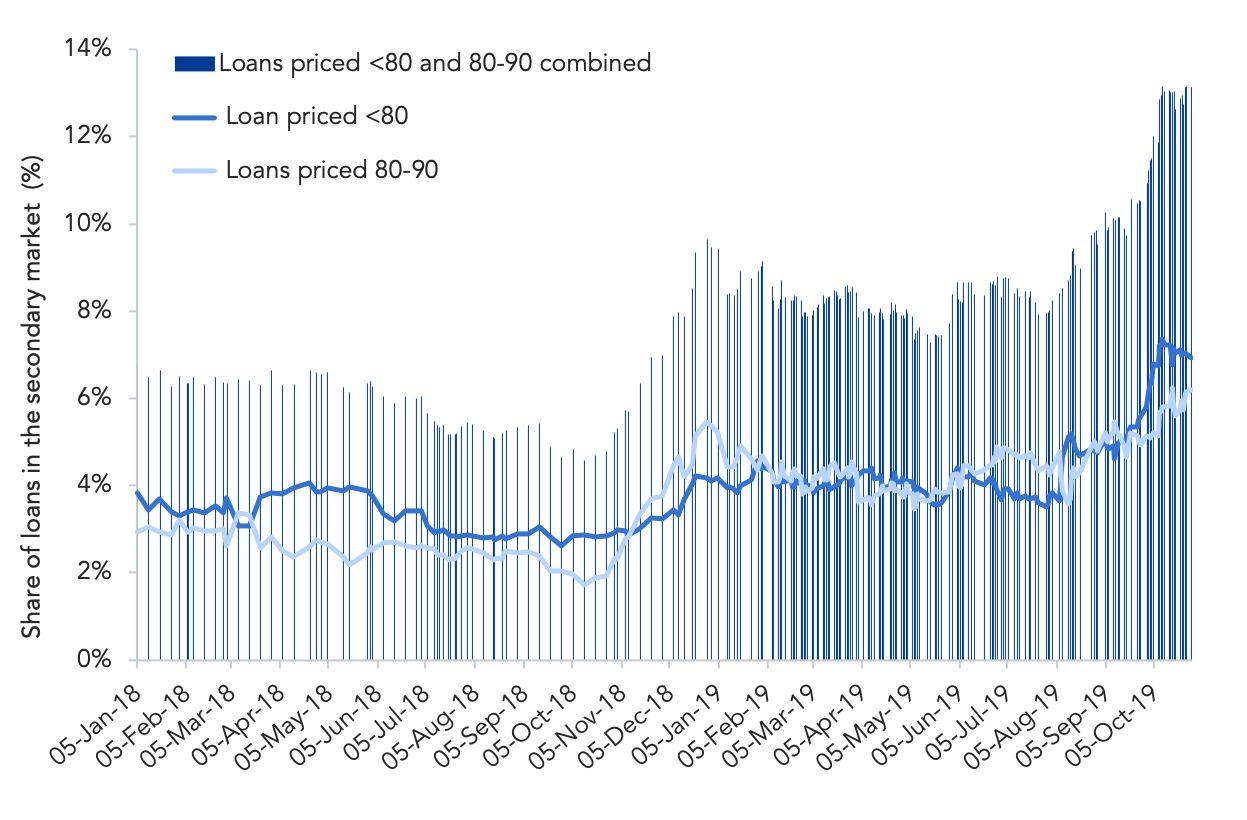
Source: Debtwire Par, Markit
The leveraged loan market has become more bifurcated, with underperforming credits getting hit harder in the secondary market. Despite the loan default rate remaining low in the 1.5% area, the share of loans priced at less than 90 cents on the dollar in the secondary market has climbed in recent months as investors have become more cautious of riskier or struggling borrowers. In turn, the share of loans in the sub-90 price category has climbed to 13%, up from 8% in August.
At the sector level, a large share of sub-90 loans are evident in the retail (28%), oil & gas (49%) and metals & mining (32%) sectors.
Portfolio managers say they are focused on the price risk of loans in their portfolio, not just credit risk. Though the default rate remains low, one buysider noted earlier this month that “everyone is dealing with their fair share of faceplants in their portfolio. They are idiosyncratic, but it’s an issue as portfolio managers are trying to recoup those losses in new investments but are worried about investing in something that is going to underperform, especially on the lower rated end, where one quarter that does not meet expectations, even if it’s positive, could result in price declines”.
Contact: Colm (CJ) Doherty

Latest news

Share of PE middle-market deal count by backing type
Add-ons remain the workhorse for middle-market deployment, accounting for 67. 1% of all middle-market transactions YTD, in line with activity seen in recent years.

Software deal share falls in middle markets, rises in large caps
In Q3’26 software’s share of total deals fell in both the Lower Middle Market (to 7%) and Upper Middle Market (to 9%), while Large Cap saw a modest uptick in share to 8%.

Secondary loan prices stabilize following steep declines
Secondary loan prices came under significant pressure through September and October, with the Bloomberg U.S. Leveraged Loan Index declining 119…