
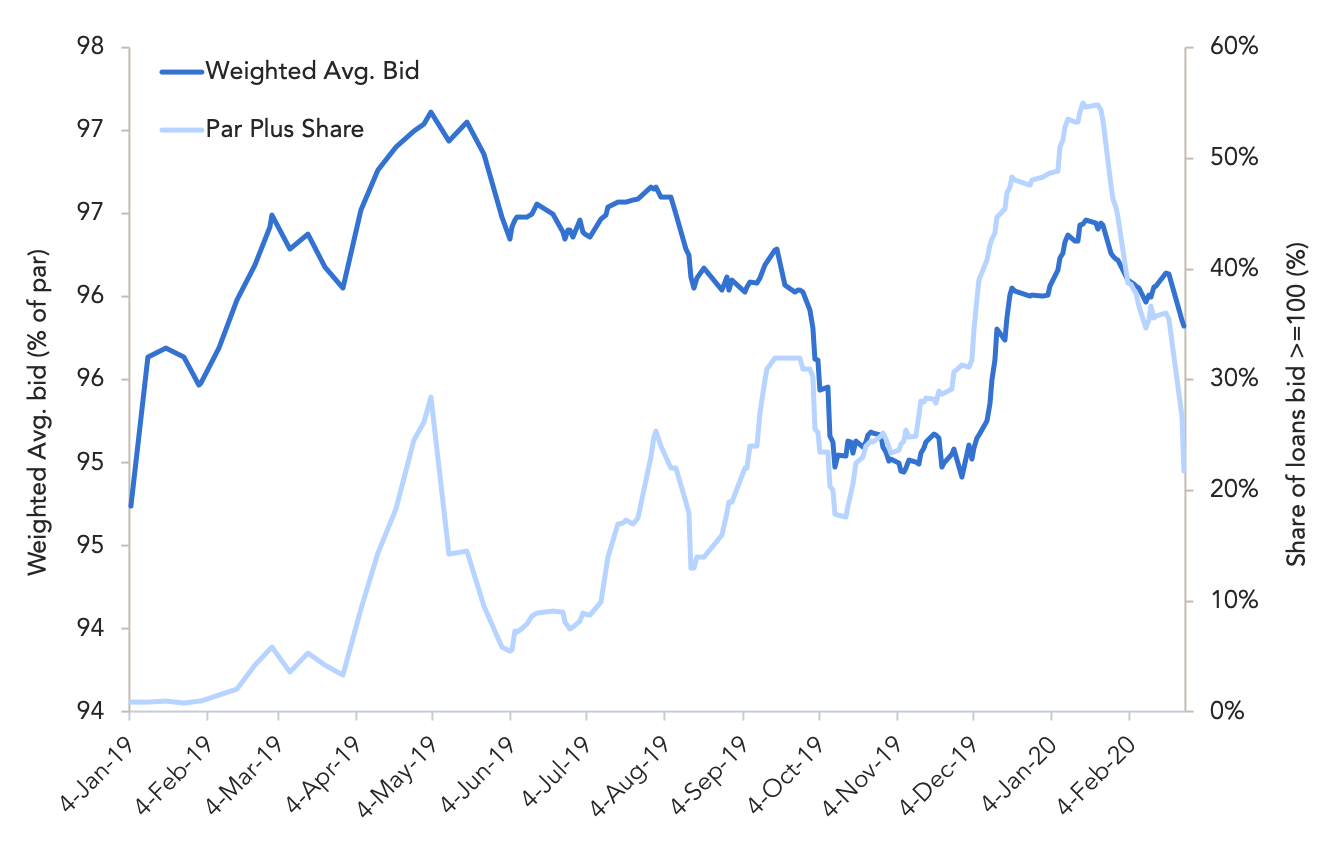
Source: Debtwire Par, Markit
With fears around the spread of the coronavirus growing, loan investors are faced with the decision to reduce risk or buy the recent dip in the secondary market. After several months defined by repricings, tightening spreads, and elevated secondary market pricing, the weighted average bid hit a recent high at 96.46 with a par plus share in the 55% area in mid-January. Investors are now weighing the impact of the coronavirus on corporate earnings, as the share of loans bid above par in the secondary market has more than halved to 22%, while the average bid has dipped to 95.82.
Though the impact has largely been seen across the board, sources have noted the travel and tourism industries are particularly at risk in the short term. Indeed, the weighted average bid has slipped to 99.29 from 100.15 in the gaming and hotel sector. Cracks have also begun to show at the lower end of the market, where distressed energy names have struggled.
While secondary prices have softened, the primary loan market has held up relatively well, with nearly USD 3bn of institutional loans allocating so far this week. Recent equity market losses have eclipsed those in the loan market, however the dip in loan prices has still allowed some buysiders the opportunity to gain precious yield in an otherwise tight market.
Contact: Vincent Daigger


Latest news
Top 50 BDCs Accounted for 75% of Nonaccrual Loan Cost in Q2’26
The 50 largest BDCs, on the basis of total debt investments as of the second quarter of 2026, accounted for 75% of the total aggregate reported value of nonaccrual debt at cost and fair value.

US private debt AUM ($B) by channel
In 2025 and the early part of 2026, the retail channel added AUM to the asset class at a much faster rate than institutional investors in both regions, with growth rates of 43.7% globally, 41.4% in the US, and 73. 1% in Europe through the beginning of 2026 compared with year-end 2024 figures.