
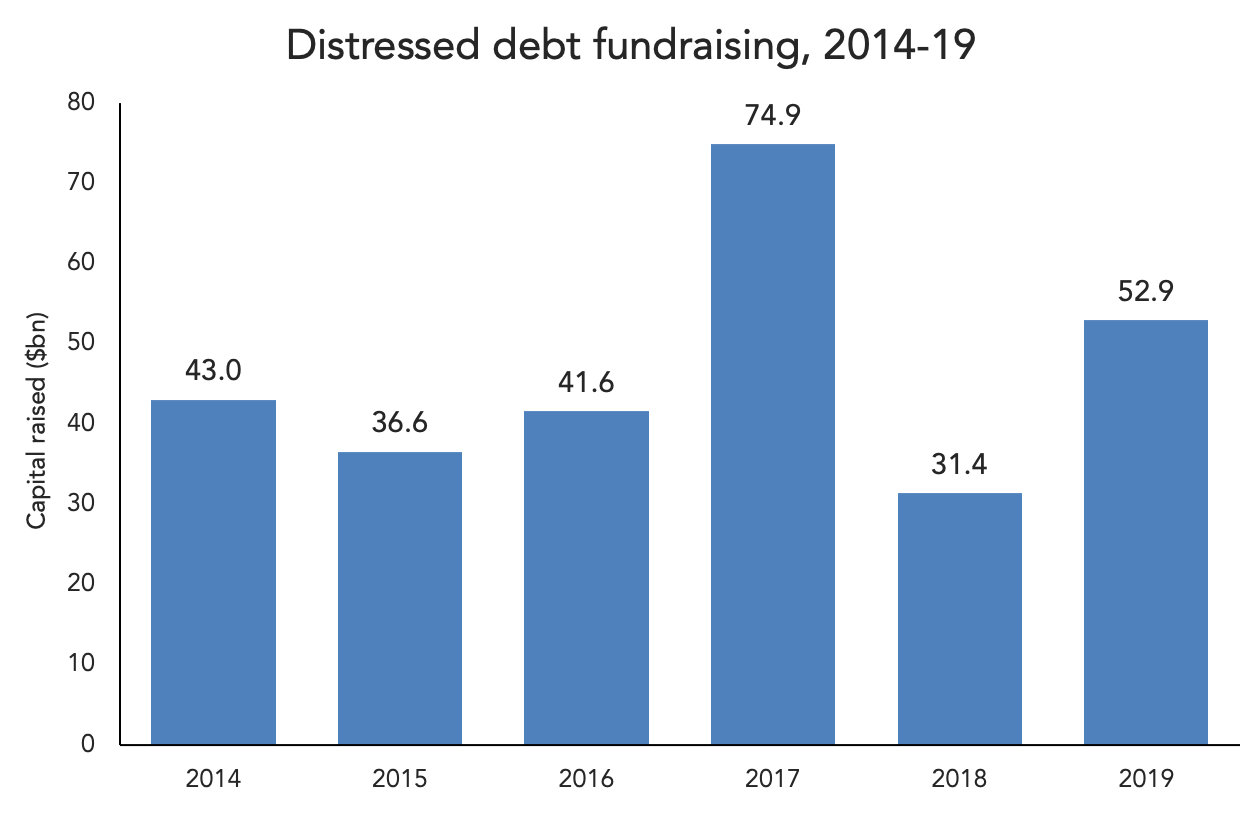
Amid a subdued year for private debt fundraising in 2019, distressed debt proved to be a magnet for investors.
Last year saw the lowest level of private debt fundraising since 2014, indicating that the asset class may be losing some of its sheen – or that investors are taking a pause for breath after the record-breaking fundraising year of 2017.
However, one area of private debt bucked the trend. Distressed debt fundraising climbed in 2019, raising more capital than any other strategy. Figures from the PDI database show distressed made up 36 percent of the total raised last year – coincidentally, for the first time since 2014.
So, what’s going on in the distressed space? One factor could be default rates, which have been stuck at low levels for the past few years. With evidence that these rates are starting to tick up, signs of market distress are becoming more apparent. Investors may be making a renewed push into distress as they anticipate slow growth translating into defaults in 2020.
There is also a chance that relatively lax lending documentation and covenant-lite loans have kept some distressed companies out of the limelight over the last couple of years. This could have resulted in a build-up of problems that have not surfaced but which will eventually come to light. However, when these assets do finally become distressed, they may be in such a weakened financial situation that they may not be suitable for a turnaround and will be beyond saving.
One thing’s for sure: plenty of capital will be available once any downturn does hit. Five of the ten largest funds closed since 2014 are distressed in focus, which means there are some huge vehicles to be put to work.



Latest news

Top 50 BDCs Accounted for 75% of Nonaccrual Loan Cost in Q2’26
The 50 largest BDCs, on the basis of total debt investments as of the second quarter of 2026, accounted for 75% of the total aggregate reported value of nonaccrual debt at cost and fair value.

US private debt AUM ($B) by channel
In 2025 and the early part of 2026, the retail channel added AUM to the asset class at a much faster rate than institutional investors in both regions, with growth rates of 43.7% globally, 41.4% in the US, and 73. 1% in Europe through the beginning of 2026 compared with year-end 2024 figures.