
Download PitchBook’s Report here.
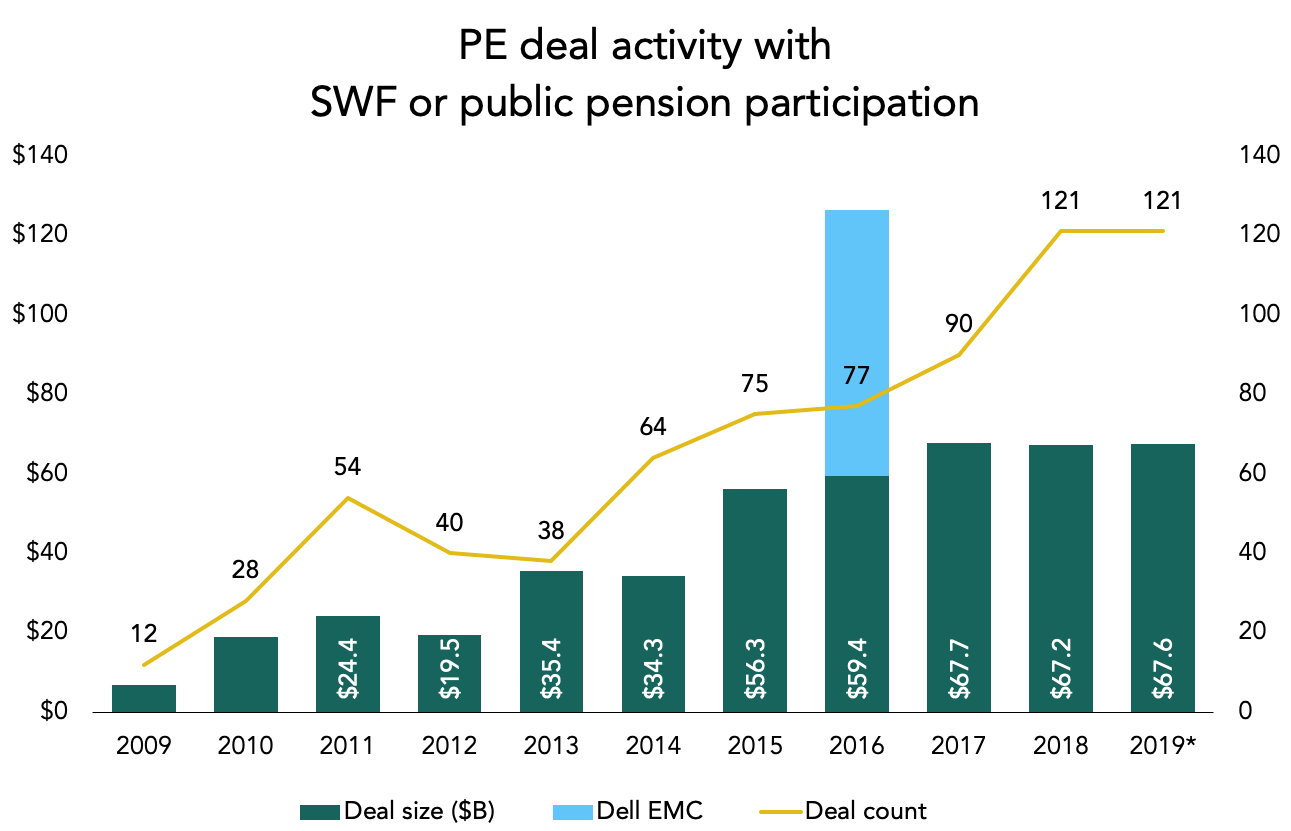
Sovereign wealth funds and public pensions financed private equity for years before they began co-investing in deals alongside their GPs. Though the trend is well publicized, the practice is still rare overall. Pension funds co-invest in about 2% of all US deals while SWFs contribute to less than 1%. Predictably those percentages go up for much larger deals, with 12.3% of $1B+ transactions involving either pensions or SWFs. Even if the proportions are relatively small, those types of deal structures are happening more often. According to our just-released 2019 Annual Breakdown report, PP/SWF activity matched 2018’s high in total co-invested deals while combined deal value has reached $67 billion for three straight years.
As with most things in life, more practice means better outcomes. In part, the uptick in activity represents a small number of SWFs and pension plans becoming more sophisticated investors, a trend we expect to continue this year. Direct deals and co-investments help reduce fee drag and give LPs better control over their uncalled commitments. Many of them have concerns around their own unfunded liabilities, and the superior returns from co-investments help chip away at those issues. But getting into those promising deals while avoiding the bad ones means having a capable team in place to vet them.
Quality talent is required to do that, and poaching Wall Street’s best investors isn’t easy. Aside from convincing them to give up their gigs, salaries are disclosed for public pension employees, and the best managers will command price tags that aren’t easy to defend politically. Much harder to defend, however, is unfunded liabilities down the road; According to Milliman, the 100 biggest US public pension plans have an aggregate funded status of around 70%, meaning current assets only cover 70% of future liabilities. In many individual cases the percentage is much lower—several are below 40%. An experienced (and well-paid) in-house deal team is easier to justify if its framed in that context. Fee savings and improved returns should be prioritized because future retirees need them to be prioritized ahead of time.



Latest news

US leveraged loans returns turn negative in October
The Bloomberg US Leveraged Loan Index (Ticker: LOAN) has returned -0.26% this month through October 21, reducing its year-to-date return…

M&A activity begins to tick upward
In the third quarter of 2026, acquisition-linked loan volume across North America and Europe reached about $47 billion, up from $30.6 billion in Q2 and $29.5 billion a year ago.